



















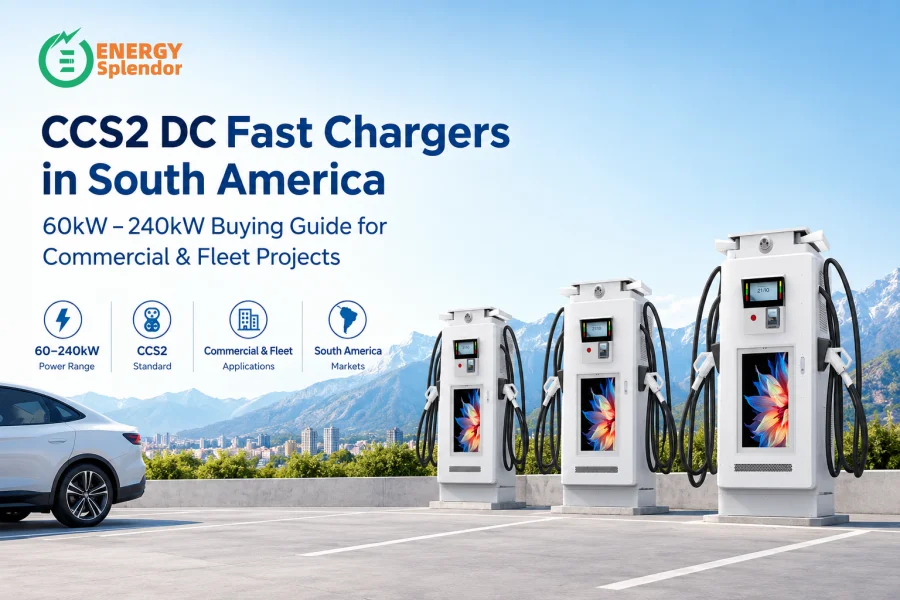
The demand for fast and reliable EV charging infrastructure is increasing across South America, particularly for commercial fleets, public charging networks, logistics operations, dealerships, parking facilities, and highway charging sites.
For many new charging projects, CCS2 DC fast charging is becoming an important configuration to consider, especially as more European and Chinese EV models enter Latin American markets. Colombia’s 2025 regulatory framework, for example, specifies at least one CCS Combo 2 connector for public DC charging stations.
For businesses planning a charging project, however, choosing a CCS2 charger is not simply about selecting the highest kW rating.
The right solution depends on vehicle compatibility, charging demand, grid capacity, site conditions, operating hours, and future expansion plans.
This guide explains how to choose a 60kW, 120kW, 180kW, or 240kW CCS2 DC fast charger for commercial and fleet applications in South America.
What Is a CCS2 DC Fast Charger?
CCS2, or Combined Charging System Combo 2, combines AC and DC charging interfaces into a standardized vehicle charging system.
A CCS2 DC fast charger supplies DC power directly to the vehicle battery, allowing significantly faster charging than conventional AC charging.
Modern DC charging systems are covered by the IEC 61851 family of standards, while IEC 62196 covers EV plugs, vehicle connectors, and vehicle inlets. IEC 61851-24 specifically addresses digital communication between DC EV supply equipment and the vehicle.
For commercial charging projects, CCS2 is particularly suitable when vehicles need to return to service quickly.
Typical applications include:
- Commercial EV charging stations
- Electric fleet depots
- Logistics and delivery fleets
- Highway charging hubs
- Shopping centers and parking facilities
- Hotels and commercial properties
- EV dealerships
- Corporate charging sites
CCS2 Charging in South America
South America is not a completely uniform EV charging market. Connector requirements, vehicle fleets, electrical regulations, utility conditions, and import requirements can differ between countries.
This makes local market compatibility an important part of charger procurement.
Brazil
Brazil is the largest EV market in the region and has a diverse vehicle fleet. Projects should therefore evaluate connector compatibility, electrical infrastructure, communication requirements, and applicable Brazilian standards before purchasing equipment.
Brazil’s conductive EV charging systems fall under the IEC 61851 series, incorporated into Brazil as ABNT NBR IEC 61851. INMETRO currently states that there is no mandatory INMETRO certification requirement specifically for conductive EV charging systems.
Chile
Chile is an important market for commercial and high-power EV charging, including charging infrastructure for highways, commercial locations, fleets, and industrial applications.
For larger sites, the charger specification should be evaluated together with transformer capacity, switchgear, cable sizing, and potential energy storage.
Colombia
CCS2 is particularly relevant in Colombia. Resolution 40559 of 2025 establishes CCS Combo 2 as the minimum connector standard for public DC charging stations.
For commercial operators, this makes CCS2 an important consideration when planning new DC charging infrastructure.
Argentina and Peru
Argentina and Peru are also developing EV charging infrastructure, creating opportunities for commercial charging stations, fleet depots, dealerships, and other high-use locations.
Because vehicle imports and charging infrastructure can vary by market, buyers should confirm the required connector configuration before placing a large equipment order.
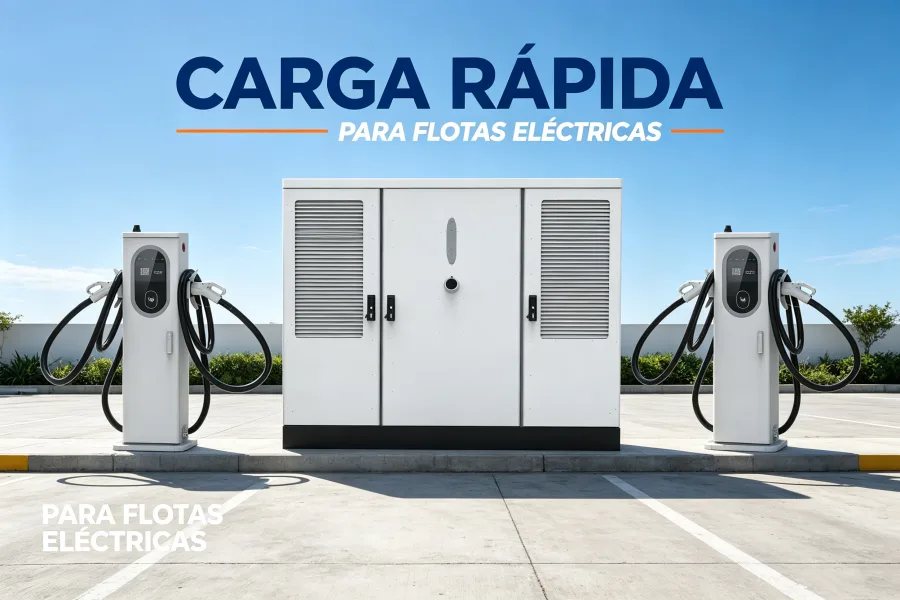
60kW vs. 120kW vs. 180kW vs. 240kW CCS2 Chargers
The correct charging power depends on the site’s operational requirements rather than simply choosing the largest charger available.
| Charger Power | Typical Application | Best Suited For |
|---|---|---|
| 60kW | Commercial and destination fast charging | Dealerships, hotels, small fleets |
| 120kW | High-use commercial charging | Parking, retail, fleet charging |
| 180kW | High-throughput DC charging | Commercial fleets, charging hubs |
| 240kW | High-power charging | Large fleets, public charging hubs, logistics |
A 60kW charger may be sufficient for a location where vehicles remain parked for longer periods.
A 120kW–180kW charger can be more suitable when vehicles need faster turnaround.
A 240kW charger becomes attractive when the site has high charging demand and sufficient electrical capacity.
How Much Electrical Power Does a CCS2 Charging Site Need?
One of the most common mistakes in commercial EV charging projects is focusing on charger output without checking the site’s available electrical capacity.
For example:
4 × 120kW DC chargers = 480kW maximum charging output
If a project uses:
4 × 240kW chargers = 960kW maximum charging output
The actual electrical design must also account for other site loads, transformer capacity, distribution equipment, protection, cable sizing, and charging utilization.
A commercial charging project may therefore require:
Utility Grid → Transformer → Main Switchgear → AC Distribution → DC Fast Chargers
The EMS (Energy Management System) operates through communication and monitoring rather than acting as a power device. It can coordinate charging loads, energy storage, meters, and other energy assets.
When Should You Consider BESS?
Battery Energy Storage Systems (BESS) can be useful when a charging site has limited grid capacity or significant peak demand.
A conventional configuration may look like:
Grid → Transformer → DC Chargers
A more advanced configuration can combine:
Grid + Solar PV + BESS → EMS → EV Chargers
Depending on the project design, BESS can help with:
- Peak shaving
- Demand management
- Limited grid capacity
- Solar energy utilization
- High-power charging
- Future charger expansion
For commercial projects, the decision to add BESS should be based on electricity tariffs, available grid capacity, charging demand, solar generation, and the site’s operating profile.
Key Specifications to Check Before Buying a CCS2 DC Fast Charger
When comparing suppliers, don’t evaluate the charger based on kW alone.
1. Output Power
Common commercial configurations include 60kW, 120kW, 180kW, and 240kW.
2. Output Voltage
High-power chargers may support a wide DC voltage range to accommodate different EV battery architectures.
For example, Energy Splendor’s 60kW–240kW DC charger range specifies 150–1000V DC output.
3. CCS2 Connector
Confirm:
- Number of charging guns
- CCS2 configuration
- Cable length
- Maximum charging current
- Compatibility with your target vehicle fleet
4. OCPP Communication
For networked commercial charging, confirm the supported OCPP version and compatibility with the intended charging management platform.
Energy Splendor’s current 60kW–240kW range supports OCPP 1.6 and is designed for commercial and fleet applications.
5. Cooling System
Higher-power chargers generate more heat.
Air cooling can be suitable for many installations, while liquid cooling can become more attractive for higher-power or demanding operating environments.
6. Protection and Enclosure
Outdoor commercial charging stations should be evaluated for:
- IP protection
- Overvoltage protection
- Overcurrent protection
- Short-circuit protection
- Temperature protection
- Surge protection
- Emergency stop functions
Read More:How Much Does a Commercial EV Charging Station Cost in 2026? Complete Cost Breakdown
What Does a Complete Commercial Charging Project Include?
The charger is only one component of a complete EV charging project.
A typical project may include:
DC Fast Charger
Transformer
Main Switchgear
Distribution Equipment
AC/DC Cables
Civil Works
Installation & Commissioning
OCPP / Charging Management
EMS
Optional Solar PV
Optional BESS
This is why comparing suppliers only by the DC charger unit price can lead to an inaccurate assessment of the total project cost.
How to Choose a CCS2 DC Fast Charger Supplier
For commercial and fleet projects, buyers should evaluate the supplier across several areas:
Product Capability
Does the manufacturer provide the required power range, connector configuration, voltage range, and cooling system?
Customization
Can the supplier provide different:
- Charging power
- Connector configurations
- Cable lengths
- Communication options
- Cabinet configurations
- Branding and OEM solutions
Certifications & Standards
Request the manufacturer’s technical documentation and applicable test reports for the target market.
Factory Capability
For distributors, EPC companies, and charging operators, direct manufacturer supply can provide better flexibility for:
- Wholesale purchasing
- OEM branding
- Large projects
- Product customization
- Repeat orders
Project Support
A commercial charger supplier should be able to provide technical specifications, installation documentation, wiring information, commissioning support, and communication protocols.
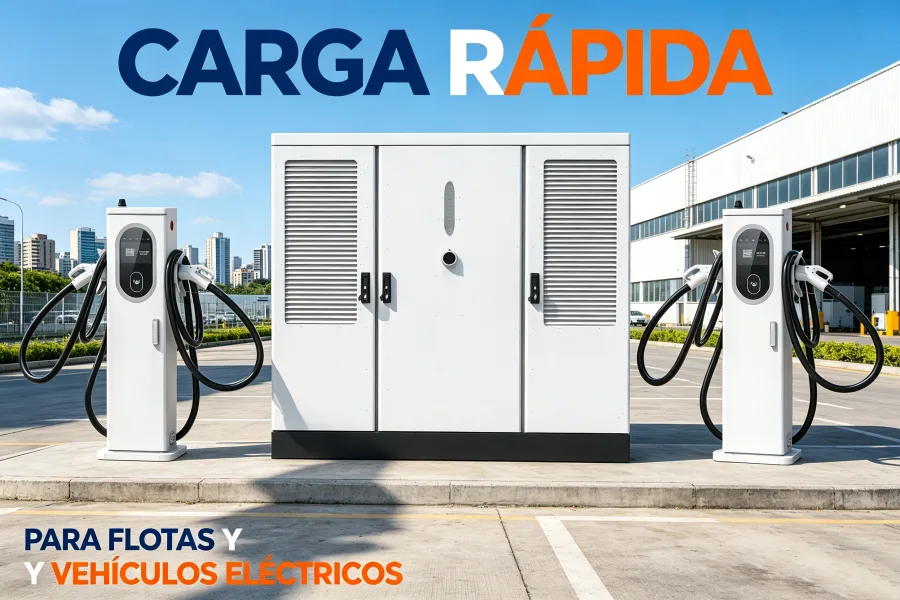
Energy Splendor CCS2 DC Fast Chargers
Energy Splendor provides high-power DC fast charging solutions from 60kW to 240kW for commercial and fleet applications.
The product range includes:
- 60kW DC fast chargers
- 120kW DC fast chargers
- 160kW DC fast chargers
- 240kW DC fast chargers
The chargers support configurations including CCS2, with product specifications including 380V three-phase AC input, 150–1000V DC output, IEC 61851, ISO 15118, and OCPP 1.6.
Energy Splendor can also integrate EV charging with solar PV, BESS, and EMS for larger commercial and fleet energy infrastructure projects.
Final Buying Checklist for South American EV Charging Projects
Before requesting a quotation, prepare the following information:
- Country and project location
- Number of chargers
- Required charger power
- Number of charging guns
- CCS2 requirement
- Available grid capacity
- Transformer information
- Installation environment
- Number of charging bays
- Estimated daily charging sessions
- OCPP requirement
- Solar PV requirement
- BESS requirement
- Delivery destination
- Expected project schedule
Providing this information allows the supplier to recommend the appropriate charger configuration and electrical infrastructure instead of simply quoting a standard unit.
Get a CCS2 DC Fast Charger Project Quote
Planning a commercial or fleet EV charging project in Brazil, Chile, Colombia, Argentina, Peru, or another South American market?
Energy Splendor can provide 60kW–240kW CCS2 DC fast charging solutions for commercial charging stations, fleet depots, parking facilities, dealerships, and high-power charging hubs.
Send us your project location, charger quantity, required power, vehicle type, and available grid capacity to discuss the appropriate charging configuration.
Get a Commercial EV Charging Project Quote