



















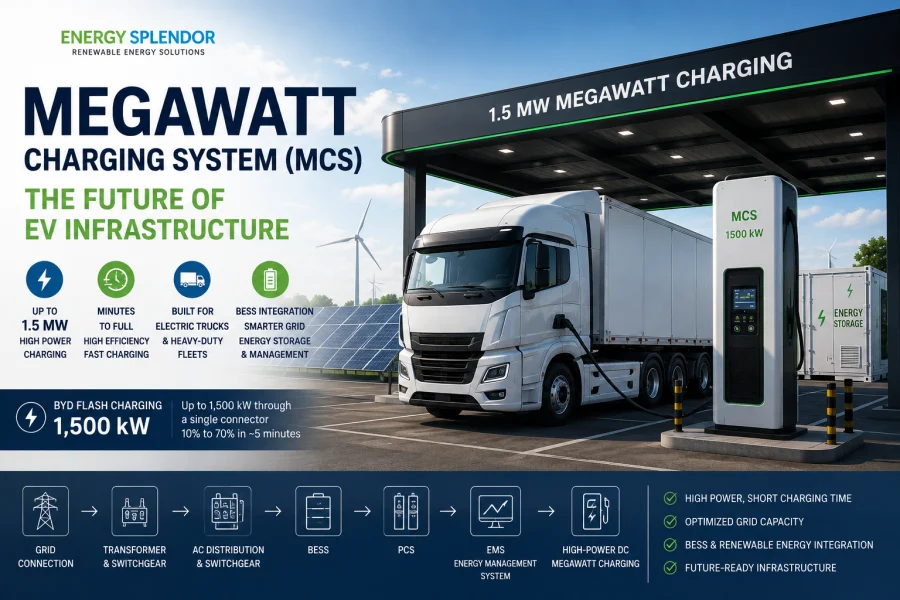
The EV charging industry is entering a new power era.
For years, DC fast charging has focused on power levels such as 60 kW, 120 kW, 180 kW, 240 kW and 360 kW. Today, the market is moving toward megawatt-class EV charging, with charging systems capable of delivering 1 MW, 1.2 MW, 1.5 MW and potentially even higher power levels.
One of the most significant developments is BYD’s FLASH Charging technology, which can deliver up to 1,500 kW through a single connector under its Chinese-market specification. BYD has also announced plans to deploy 20,000 FLASH Charging stations in China by the end of 2026, with international expansion underway.
At the same time, the broader Megawatt Charging System (MCS) ecosystem is developing standards and infrastructure for high-power charging, particularly for electric trucks, buses and other heavy-duty vehicles.
For fleet operators, charging developers, EPC contractors and energy infrastructure companies, the question is no longer whether charging power will reach the megawatt level.
The question is:
How should commercial charging infrastructure be designed for the megawatt era?
What Is a Megawatt Charging System?
A Megawatt Charging System (MCS) is a high-power DC charging technology designed primarily for medium- and heavy-duty electric vehicles.
The objective is to deliver very large amounts of energy in a short charging window.
The U.S. Department of Energy’s Alternative Fuels Data Center currently describes MCS as a technology under development for DC charging up to 3.75 MW, including short-dwell charging and lower-power overnight charging for medium- and heavy-duty applications.
Compared with conventional passenger EV charging, megawatt charging requires a fundamentally different approach to:
- Power distribution
- Transformer capacity
- Switchgear
- Charging cables
- Isı yönetimi
- Protection systems
- Şebeke bağlantısı
- Pil enerjisi depolama
- Enerji yönetimi
The charger itself is only one part of the system.
Why Is Megawatt Charging Important?
Heavy-duty electric vehicles have much larger batteries and higher daily energy requirements than passenger cars.
A long-haul electric truck may need hundreds of kilowatt-hours of energy during a working day. If charging takes several hours, vehicle utilization can be significantly affected.
Megawatt-class charging changes the charging model.
Instead of relying only on long overnight charging, a truck can potentially receive a substantial amount of energy during a scheduled break or short stop.
This is particularly important for:
- Long-haul electric trucks
- Logistics fleets
- Distribution vehicles
- Elektrikli otobüsler
- Madencilik araçları
- Port vehicles
- Industrial fleets
- Otoyol şarj istasyonları
- Large commercial fleets
The higher the vehicle utilization requirement, the more valuable high-power charging becomes.
BYD and the Rise of 1.5 MW FLASH Charging
One of the most visible examples of megawatt-class charging deployment is BYD FLASH Charging.
In March 2026, BYD announced its second-generation FLASH Charging technology with charging power of up to 1,500 kW through a single connector, based on its Chinese-market specification. BYD stated that compatible vehicles could charge from 10% to 70% in approximately five minutes and from 10% to 97% in about nine minutes under suitable conditions.
This is an important milestone because it demonstrates that megawatt-class charging is moving beyond laboratory demonstrations and into commercial deployment.
BYD also reported that it had already installed 4,239 FLASH Charging stations in China as of March 5, 2026, with a target of 20,000 stations by the end of 2026.
BYD subsequently expanded the technology internationally. Its DENZA brand introduced FLASH Charging in Europe, and BYD stated plans for 6,000 FLASH Charging stations outside China within 12 months, including 3,000 in Europe.
What Does This Mean for the EV Charging Industry?
The significance of BYD’s approach is not simply the 1,500 kW charging number.
It demonstrates that extremely high charging power can be combined with an integrated energy infrastructure strategy.
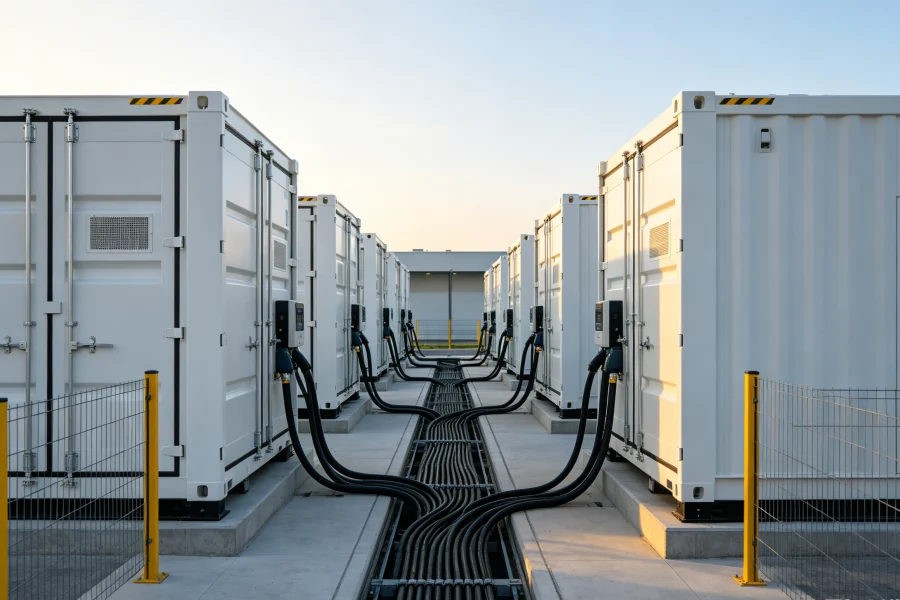
BYD has described its FLASH Charging stations as being paired with an energy storage system that can help overcome grid limitations by storing energy at a lower rate and supplying additional power during high-power charging.
This is an important concept for the entire commercial EV charging industry:
Megawatt charging and energy storage are increasingly becoming interconnected.
BYD FLASH Charging vs. MCS
BYD FLASH Charging and MCS are related to the same broader trend, but they should not be treated as identical technologies.
BYD FLASH Charging is BYD’s proprietary high-power charging solution.
Megawatt Charging System (MCS) is an industry-wide technology and standardization effort focused on very high-power charging, particularly for medium- and heavy-duty vehicles.
This distinction is important for charging infrastructure developers.
A commercial project should not select equipment simply because it has a “megawatt” label.
The vehicle, charger, connector, communication system, grid infrastructure, energy storage and applicable regional standards all need to work together.
MCS Standards Are Moving Forward
The development of megawatt charging is also being supported by international standardization.
IEC has been developing IEC 61851-23-3, covering DC EV supply equipment for Megawatt Charging Systems. The IEC’s 2026 materials identify MCS as an emerging technology for high-power charging of heavy-duty vehicles.
IEC has also published IEC TS 63379:2026, covering vehicle couplers, vehicle inlets and cable assemblies for megawatt DC charging, including systems rated up to 1,500 V DC and 3,000 A under the specified architecture.
This standardization work is important because megawatt charging cannot scale globally without clear requirements for:
- Electrical safety
- Vehicle connectors
- Cable systems
- Isı yönetimi
- İletişim
- Charging control
- Interoperability
- Kurulum gereksinimleri
As standards mature, MCS is expected to become increasingly relevant to heavy-duty charging infrastructure projects.
Why a 1 MW or 1.5 MW Charger Is Not Just a Bigger DC Charger
A common misunderstanding is that a megawatt charger is simply a conventional DC charger with a larger power rating.
In reality, the infrastructure requirements can be substantially different.
Consider a charging site with:
4 × 1 MW chargers
If all four chargers operate at maximum output simultaneously, the theoretical charging load could reach:
4 MW
Add transformer losses, auxiliary loads, HVAC, lighting, BESS charging and other site loads, and the actual electrical infrastructure requirement becomes even more complex.
This is why megawatt charging projects must be designed as energy infrastructure projects, not simply charger installation projects.
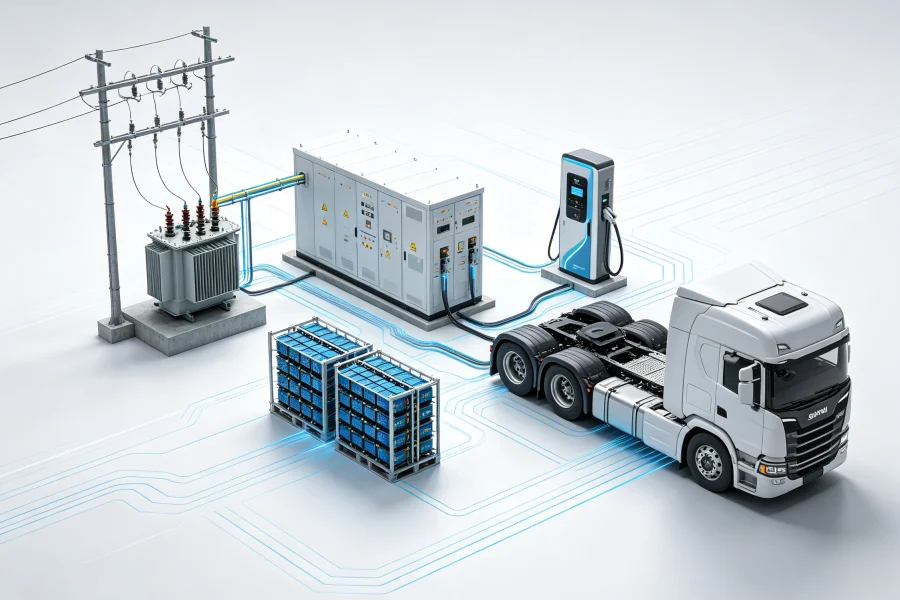
Typical Megawatt EV Charging Infrastructure
A commercial high-power charging site can include:
Utility Grid → Transformer → Main Switchgear → AC Distribution → PCS/BESS → High-Power DC Charging → Electric Vehicles
An Enerji Yönetim Sistemi (EMS) operates at the control and monitoring layer rather than as a power device.
The EMS can communicate with:
- Smart meters
- Main switchgear
- PCS
- BESS
- Elektrikli araç şarj cihazları
- PV inverters
- Site energy management systems
This allows the charging site to coordinate power demand and energy resources.
A simplified architecture can be:
Grid + Solar PV + BESS + EMS + High-Power DC Charging
This integrated approach becomes increasingly valuable as charging power rises.
Why BESS Is Important for Megawatt Charging
Grid capacity is one of the biggest challenges for high-power EV charging.
A site may have sufficient energy consumption over an entire day but insufficient grid capacity to support extremely high instantaneous charging demand.
For example, a fleet depot may need 5 MWh of charging energy per day but only have a limited grid connection.
The solution is not necessarily to install a much larger grid connection.
A Pil Enerji Depolama Sistemi (BESS) can be used to shift energy and support charging peaks.
During low-demand periods:
Grid → BESS
During high-power charging:
Grid + BESS → EV Chargers
With solar generation:
Solar PV + Grid + BESS → EV Chargers
This architecture can help operators:
- Reduce peak grid demand
- Optimize available grid capacity
- Support high-power charging
- Reduce charging bottlenecks
- Improve energy flexibility
- Prepare for future fleet expansion
For large commercial projects, BESS can therefore become a critical part of the charging infrastructure rather than an optional add-on.
Solar + BESS + Megawatt EV Charging
Megawatt charging also creates an opportunity to integrate renewable energy.
A large fleet depot or charging hub can combine:
Solar PV + BESS + EMS + High-Power EV Charging
During daylight hours, solar power can directly support vehicle charging.
When solar production exceeds immediate charging demand, excess energy can be stored in the BESS.
When charging demand rises, the BESS can discharge to support the chargers.
The EMS coordinates the system according to:
- Güneş enerjisi üretimi
- Grid capacity
- Battery state of charge
- EV charging demand
- Time-of-use electricity rates
- Site load
- Charging schedules
This creates a more flexible commercial charging system.
How Much Power Does a Megawatt Charging Station Need?
There is no single answer.
The required electrical infrastructure depends on the number of chargers, maximum charging power, simultaneous charging demand and charging schedule.
For example:
| Charging Configuration | Maximum Charger Output |
|---|---|
| 4 × 240 kW | 960 kW |
| 4 × 360 kW | 1.44 MW |
| 4 × 480 kW | 1.92 MW |
| 4 × 720 kW | 2.88 MW |
| 4 × 1 MW | 4 MW |
| 4 × 1.5 MW | 6 MW |
These values represent theoretical charger output when all chargers operate simultaneously at their maximum rated power.
Actual site demand may be lower depending on vehicle demand, charging schedules, dynamic power sharing and EMS control.
This is why charger quantity alone should never be used to determine transformer size.
A proper project assessment should consider:
Fleet size + Battery capacity + Daily mileage + Charging window + Simultaneous charging + Grid capacity + Future expansion
Megawatt Charging for Electric Truck Fleets
Heavy-duty fleets are one of the strongest applications for megawatt charging.
A logistics operator may have dozens or hundreds of electric trucks returning to a depot every day.
The charging strategy could include:
Overnight Charging
Lower-power charging can replenish vehicles over several hours.
Opportunity Charging
Higher-power charging can provide additional energy during short operating breaks.
Megawatt Charging
MCS or other megawatt-class systems can support high-utilization vehicles where charging time is limited.
BESS-Assisted Charging
Battery storage can provide additional power when grid capacity is constrained.
The optimum solution is therefore not necessarily “maximum charger power everywhere.”
It is a combination of:
Vehicle Requirements + Charging Schedule + Grid Capacity + Energy Storage + Charger Power
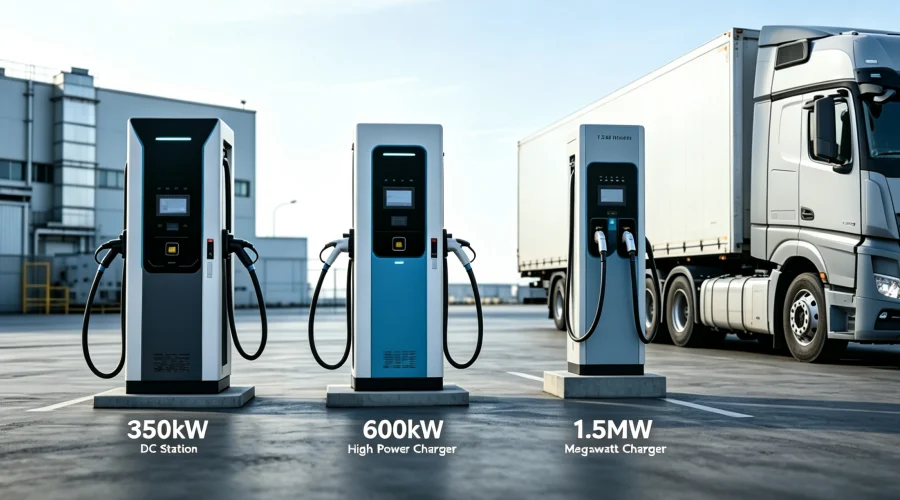
MCS vs. 360 kW, 480 kW and 720 kW DC Charging
Not every commercial EV fleet needs a megawatt charger.
For many applications, conventional high-power DC charging may provide a better balance between infrastructure cost and charging requirements.
For example:
| Başvuru | Typical Charging Strategy |
|---|---|
| Workplace EV charging | AC charging |
| Small commercial fleet | 60–180 kW DC |
| Delivery fleet | 120–360 kW DC |
| Large fleet depot | 240–720 kW DC |
| High-utilization fleet | 480 kW–1 MW+ |
| Heavy-duty truck corridor | 1 MW+ / MCS |
| Megawatt charging hub | 1 MW–3 MW+ |
The right solution depends on the operational profile.
A fleet that remains parked for eight hours does not necessarily need a 1 MW charger.
A long-haul electric truck with a short turnaround window may benefit significantly from megawatt-class charging.
What Does a Megawatt Charging Project Require?
Before developing a high-power EV charging station, project owners should evaluate the complete electrical infrastructure.
1. Utility Connection
Determine the available grid capacity and connection voltage.
2. Transformer
Select transformer capacity according to the actual charging and site load profile.
3. Switchgear
Provide appropriate switching, protection and distribution equipment.
4. High-Power DC Chargers
Select charger power based on vehicle compatibility and charging schedules.
5. BESS
Evaluate battery storage when grid capacity or peak demand is a constraint.
6. PCS
Use an appropriate power conversion system for the BESS architecture.
7. EMS
Coordinate grid, BESS, solar and EV charging demand.
8. Thermal Management
High-power charging generates significant heat, making cable, connector and power-electronics thermal management important.
9. Site Layout
Plan vehicle circulation, charger positioning, cable management, safety distances and future expansion.
10. Future Capacity
Design the electrical infrastructure with future fleet growth in mind.
The Real Opportunity: Megawatt Charging Infrastructure
The most important lesson from the development of BYD FLASH Charging and MCS is that the future of EV charging is not simply about higher charger output.
The industry is moving toward integrated energy infrastructure.
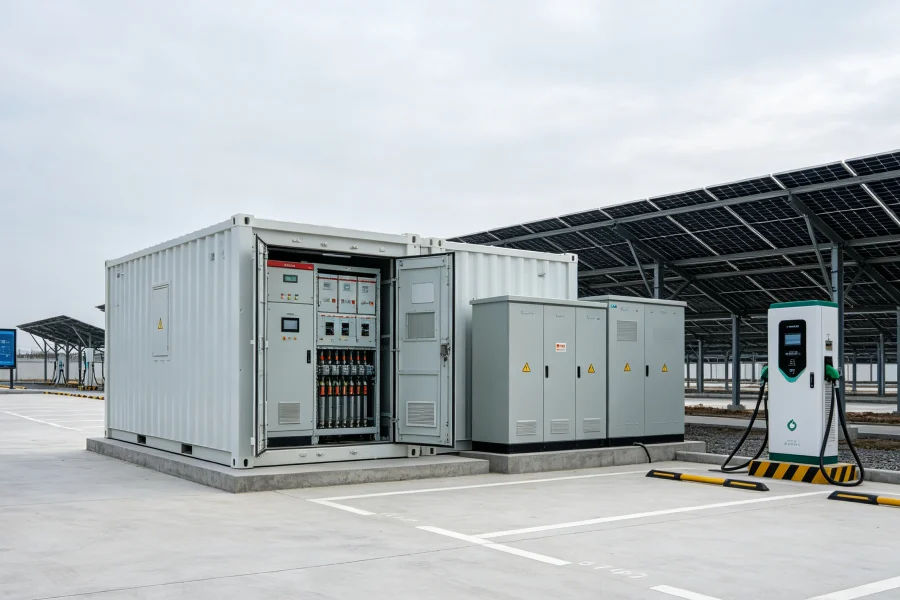
A future commercial charging hub may combine:
Tablo
Transformer & Switchgear
BESS
PCS
EMS
MCS / Megawatt-Class Charging
This architecture can provide a scalable platform for electric trucks, buses, commercial fleets and high-utilization EV charging networks.
What Does BYD’s Megawatt Charging Expansion Mean for the Market?
BYD’s rapid FLASH Charging deployment demonstrates that megawatt-class charging is becoming commercially relevant at scale.
The company announced in March 2026 that it had 4,239 FLASH Charging stations installed in China and targeted 20,000 by the end of the year. It has also announced international expansion, including plans for 6,000 stations outside China within 12 months.
The European rollout is particularly important for the global charging market.
BYD stated that DENZA vehicles would introduce FLASH Charging to European customers, with the technology capable of up to 1,500 kW under its specified configuration.
This does not mean every European or North American charging station will immediately move to 1.5 MW.
Instead, it shows where the technology direction is heading:
Higher power + shorter charging time + energy storage + smarter grid management.
For charging operators and infrastructure developers, preparing for this transition now can reduce the risk of expensive infrastructure upgrades later.
Is Megawatt Charging the Future of EV Charging?
For heavy-duty transportation, the answer is increasingly yes.
The combination of larger batteries, higher vehicle utilization and shorter charging windows is creating demand for charging power far beyond traditional passenger EV charging.
However, megawatt charging will not replace every existing charging technology.
AC charging, 120 kW DC charging, 240 kW DC charging, 360 kW DC charging and 480 kW+ systems will continue to serve applications where long dwell times make extremely high charging power unnecessary.
The future charging ecosystem will therefore be diversified:
AC → DC Fast Charging → High-Power DC → 1 MW+ Charging → MCS
The key is matching charging power to the actual vehicle and fleet operation.
Sonuç
The rise of Megawatt Charging Systems (MCS) represents a major shift in commercial EV infrastructure.
BYD’s FLASH Charging technology demonstrates how 1 MW-class and 1.5 MW-class charging can move toward large-scale deployment, while international MCS standards are developing to support the wider heavy-duty charging ecosystem.
For commercial fleets, electric trucks and charging hubs, the future is not simply about installing a larger charger.
The real challenge is designing the complete energy system around it.
Grid + Transformer + Switchgear + BESS + PCS + EMS + Solar + High-Power EV Charging
This integrated approach can help charging operators build scalable infrastructure capable of supporting today’s commercial EVs and tomorrow’s megawatt-class electric transportation.
Planning a High-Power EV Charging Project?
Energy Splendor provides integrated solutions for commercial EV charging, high-power DC fast charging, BESS, solar PV, EMS, transformers, switchgear and grid-connected charging infrastructure.
Whether you are planning a fleet depot, logistics charging hub, commercial parking facility or future megawatt charging station, the system should be designed around your actual power demand, charging schedule and future expansion requirements.
Get a Commercial EV Charging Project Quote