



















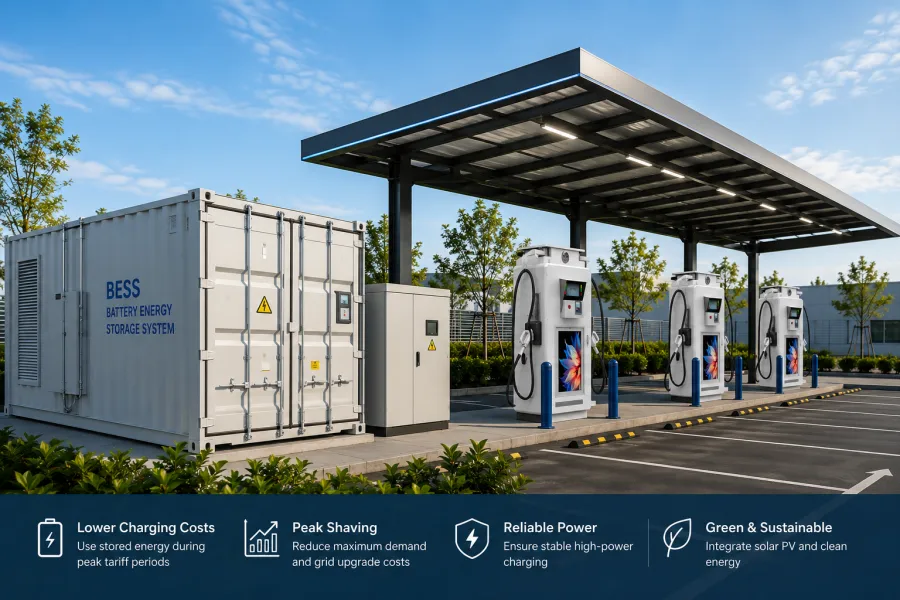
Europe is entering a new stage of electric vehicle infrastructure development.
The demand for EV charging is no longer limited to residential AC charging. Commercial fleets, logistics companies, public charging operators, shopping centers, workplaces, highway service areas and industrial facilities increasingly require high-power DC fast charging infrastructure that can support multiple vehicles while managing limited grid capacity.
For businesses planning an EV charging project in Europe, installing the charger itself is only one part of the solution.
A complete commercial EV charging infrastructure may include:
- DC hızlı şarj cihazları
- AC elektrikli araç şarj cihazları
- Medium-voltage or low-voltage grid connection
- Transformers
- Main switchgear
- Distribution equipment
- Güneş Enerjisi (PV)
- Pil Enerji Depolama Sistemleri (BESS)
- Power Conversion Systems (PCS)
- Enerji Yönetim Sistemleri (EMS)
- Smart charging and load management
- OCPP-based charging management
- Civil and electrical installation
This guide explains how to design, size and evaluate commercial EV charging infrastructure in Europe in 2026, including charger power, grid capacity, BESS, solar integration, standards, costs and supplier selection.
Why EV Charging Infrastructure in Europe Is Expanding
Europe’s EV market is increasingly dependent on reliable public and commercial charging infrastructure.
According to the IEA’s 2026 Global EV Outlook, charging infrastructure continues to expand rapidly across Europe, including infrastructure along long-distance transport corridors. The EU also has more than 1,000 charging points dedicated exclusively to electric trucks, reflecting the growing need for high-power charging for commercial transportation.
At the same time, the European Union’s Alternative Fuels Infrastructure Regulation (AFIR) establishes minimum requirements for alternative-fuel infrastructure and focuses on interoperability and accessible charging infrastructure across Member States.
For commercial charging projects, this creates several important trends:
- Higher charging power
- More multi-charger charging hubs
- Greater demand for fleet charging
- Increasing grid-capacity requirements
- More sophisticated load management
- Integration of battery storage
- Greater use of renewable energy
- Increasing importance of interoperable charging systems
The result is a shift from “installing EV chargers” ...'ye “designing complete EV charging infrastructure.”
What Is Commercial EV Charging Infrastructure?
Commercial EV charging infrastructure refers to the complete electrical, energy and charging system required to provide EV charging for businesses, fleets, public charging operators and other commercial applications.
A basic system can look like this:
Elektrik Şebekesi
↓
Transformer / Main Switchgear
↓
AC Distribution
↓
DC Hızlı Şarj Cihazları
↓
Electric Vehicles
For more advanced projects, the system can also integrate:
Solar PV → PV Inverter → AC Bus
BESS ↔ PCS ↔ AC Bus
EMS → Grid + Solar + BESS + EV Chargers
This architecture allows the charging site to manage not only vehicle charging but also electricity consumption, renewable generation, battery storage and peak demand.
Types of EV Charging Infrastructure in Europe
Different commercial applications require different charging speeds.
| Charging Type | Typical Power | Typical Application |
|---|---|---|
| AC EV Charging | 7–22 kW | Offices, hotels, workplaces |
| Commercial AC Charging | 22–44 kW | Ticari otopark |
| DC Hızlı Şarj | 60–180 kW | Fleets and commercial sites |
| High-Power DC Charging | 180–360 kW | Charging hubs and fleet depots |
| Ultra-Fast Charging | 360 kW+ | Highway and high-utilization sites |
There is no single “best” charging power.
The correct configuration depends on:
- Vehicle type
- Battery capacity
- Average parking time
- Daily energy demand
- Araç sayısı
- Grid capacity
- Site operating hours
- Future expansion plans
- Electricity tariffs
- Available renewable energy
For example, a workplace may not need 360 kW charging because vehicles can remain parked for several hours.
A highway charging hub, however, may benefit from 240 kW or 360 kW DC fast chargers because short charging sessions and high charger utilization are more important.
How Much Power Does a Commercial EV Charging Site Need?
One of the most important mistakes in EV charging project design is calculating only the rated power of the chargers.
Consider a site with:
4 × 180 kW DC Chargers
The theoretical maximum charging load is:
4 × 180 kW = 720 kW
Now consider:
6 × 240 kW DC Chargers
Maximum charger output:
6 × 240 kW = 1,440 kW
Or:
8 × 360 kW DC Chargers
Maximum output:
8 × 360 kW = 2,880 kW
However, the actual site demand may be lower because not every vehicle charges at maximum power simultaneously.
This is where dynamic load management and EMS become important.
Instead of designing the grid connection for the theoretical maximum at all times, the system can dynamically distribute available power among chargers.
For example:
Grid Capacity: 1,000 kW
Available Charging Load: 1,000 kW
The EMS can dynamically allocate power between multiple vehicles according to:
- Şarj durumu
- Charging priority
- Vehicle departure time
- Charger capacity
- Site demand
- Grid constraints
This can reduce unnecessary grid upgrades while maintaining an effective charging experience.
Grid Capacity and Transformer Requirements
High-power commercial EV charging can create a substantial electrical load.
A project with several 180 kW, 240 kW or 360 kW chargers may require dedicated electrical infrastructure.
A typical high-power site may include:
Elektrik Şebekesi
↓
MV Connection
↓
MV Transformer
↓
Main Switchgear
↓
AC Distribution
↓
DC Hızlı Şarj Cihazları
Depending on the project, additional equipment may include:
- Protection devices
- Metering
- Distribution panels
- Cables
- Circuit breakers
- Surge protection
- Power quality equipment
- Communication equipment
The transformer should not be selected based only on charger nameplate power.
The engineering calculation should consider:
Existing Building Load
For example:
- HVAC
- Lighting
- Production equipment
- Refrigeration
- Office loads
EV Charging Load
Including:
- Number of chargers
- Charger power
- Simultaneous charging
- Expected utilization
Future Expansion
A site designed for four chargers today may need eight or twelve chargers in the future.
Therefore, it can be more economical to design the electrical infrastructure with expansion capacity from the beginning.
Learn More:How Much Does a Commercial EV Charging Station Cost in 2026? Complete Cost Breakdown
Why BESS Is Important for High-Power EV Charging
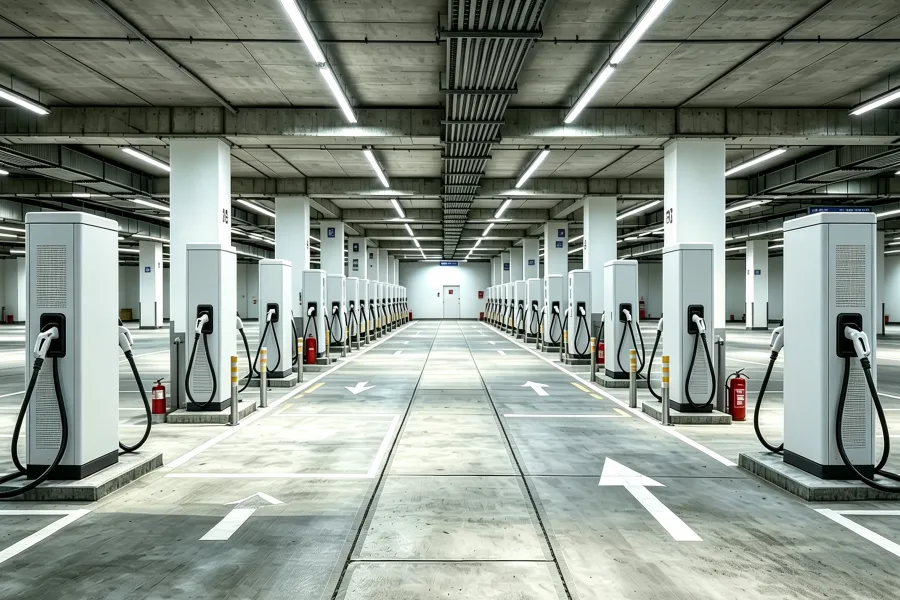
Battery Energy Storage Systems can play an important role in commercial EV charging projects where grid capacity is limited or electricity demand charges are significant.
Consider this simplified example:
Grid Capacity: 500 kW
Required EV Charging Power: 900 kW
A BESS can provide:
400 kW additional discharge power
Therefore:
500 kW Grid + 400 kW BESS = 900 kW Charging
This does not mean every project needs a BESS.
However, BESS can be valuable when:
- Grid capacity is limited
- Grid upgrades are expensive
- High-power charging creates demand peaks
- Solar energy needs to be stored
- Electricity tariffs vary by time
- The site requires peak shaving
- Future charger expansion is planned
Key BESS Functions
A commercial BESS can support:
Peak Shaving
Reduce the site’s maximum grid demand.
Load Shifting
Store energy when electricity is more favorable and discharge during high-demand periods.
EV Charging Support
Provide additional power during high-demand charging periods.
Solar Energy Storage
Store excess PV generation for later EV charging.
Grid Capacity Optimization
Reduce the amount of grid capacity required for a high-power charging site.
Solar + BESS + EV Charging for European Commercial Sites
Solar PV can further improve the energy economics of commercial EV charging.
A typical integrated system can be structured as:
Güneş Enerjisi (PV)
↓
PV Inverter
↓
AC Bus
↔
BESS + PCS
↓
EV Chargers
↕
Elektrik Şebekesi
↓
EMS
The EMS coordinates the energy flows between these components.
For example, during the daytime:
Solar → EV Charging
If solar generation exceeds charging demand:
Solar → BESS
During periods of high EV charging demand:
Solar + BESS + Grid → EV Chargers
This approach can improve renewable-energy utilization while reducing peak grid demand.
Learn More:Commercial Solar EV Charging Station with BESS: Design, Sizing & Cost Guide
Example Commercial Solar + BESS + EV Charging Configurations
The correct system size depends on the site load profile, solar resource, available space and charging demand.
Typical project concepts may include:
Commercial Workplace
100–300 kWp Solar PV
215–500 kWh BESS
120–240 kW DC Charging
Uygun olduğu durumlar:
- Corporate campuses
- Ofisler
- Commercial buildings
- Employee parking
Fleet Depot
300–800 kWp Solar PV
500 kWh–1.5 MWh BESS
240–480 kW DC Charging
Uygun olduğu durumlar:
- Dağıtım filoları
- Lojistik şirketleri
- Commercial vans
- Filo depoları
High-Power Charging Hub
1–5 MWp+ Solar PV
1–5 MWh+ BESS
480–960 kW+ DC Charging
Uygun olduğu durumlar:
- Public charging hubs
- Highway charging
- Large fleet operations
- Lojistik merkezleri
These are conceptual ranges rather than universal sizing rules. A final system should be engineered from actual load profiles, grid conditions, charging demand and local regulations.
AFIR and EV Charging Infrastructure in Europe
Şu Alternative Fuels Infrastructure Regulation (AFIR) is an important consideration for European charging infrastructure projects.
AFIR establishes requirements for the deployment of alternative-fuel infrastructure across the EU, with objectives including minimum infrastructure availability, interoperability and accessible user information and payment options.
For TEN-T corridors, AFIR includes phased requirements for charging pools and charging power. For example, EU guidance describes 2025 requirements involving charging pools with at least 1,400 kW total output and at least one 350 kW charging point on specified portions of the TEN-T network, with further increases scheduled for later years.
The European Commission is also reviewing AFIR implementation and whether existing targets are sufficient to provide coherent infrastructure coverage across EU regions.
What Does This Mean for Commercial Projects?
When planning a European charging project, developers should consider:
- Required charging power
- Public accessibility
- Payment options
- Interoperability
- Charging network communication
- Site location
- Şebeke bağlantısı
- Future capacity
- National and local electrical requirements
AFIR is only one part of compliance. Projects must also consider applicable national regulations, grid-connection rules, electrical standards and local permitting requirements.
OCPP and Smart Charging
Modern commercial charging infrastructure should not be considered only as electrical hardware.
Communication and software are equally important.
OCPP
Open Charge Point Protocol (OCPP) enables communication between EV chargers and charging management systems.
It can support functions such as:
- Uzaktan izleme
- Charger status
- Start/stop charging
- Fault management
- Enerji yönetimi
- User authorization
- Akıllı şarj
For commercial operators managing multiple chargers, network connectivity becomes increasingly important.
ISO 15118 and Plug & Charge
ISO 15118 provides communication between the EV and charging infrastructure.
Depending on vehicle and charger capabilities, it can support advanced functions such as:
- Vehicle identification
- Plug & Charge
- Akıllı şarj
- Energy-management functions
- Future vehicle-to-grid applications
For European commercial projects, compatibility with relevant communication standards should be evaluated during the equipment-selection stage rather than after installation.
How to Design a Commercial EV Charging Site
A reliable project normally starts with a site assessment.
Step 1: Analyze the EV Demand
Determine:
- Araç sayısı
- Vehicle types
- Daily mileage
- Günlük şarj enerjisi
- Average parking time
- Peak charging periods
- Required departure state of charge
Step 2: Determine Charger Power
Choose between:
- AC charging
- 60 kW DC
- 120 kW DC
- 180 kW DC
- 240 kW DC
- 360 kW DC
- Higher-power systems
The objective should not simply be choosing the largest charger.
The charger should match the actual operating model.
Step 3: Check Grid Capacity
Review:
- Existing grid connection
- Transformer capacity
- Main switchgear
- Building demand
- Available connection capacity
- Grid upgrade requirements
Step 4: Evaluate BESS
A BESS may be considered if:
- Grid capacity is insufficient
- Peak demand is expensive
- High-power charging is required
- Solar PV is available
- Future expansion is expected
Step 5: Evaluate Solar PV
Solar PV can be considered when:
- Sufficient roof or land area is available
- Charging demand occurs during solar production
- Renewable energy utilization is a priority
- The project benefits from energy storage
Step 6: Design EMS and Load Management
EMS can coordinate:
Tablo
Solar
BESS
EV Chargers
Building Loads
This creates an integrated energy management system rather than a collection of independent devices.
Commercial EV Charging Applications in Europe
Fleet Depots
Fleet operators often need predictable charging within a limited time window.
Tipik uygulama alanları şunlardır:
- Delivery vans
- Logistics fleets
- Elektrikli kamyonlar
- Service vehicles
- Corporate fleets
For fleet depots, charging schedules can be optimized around vehicle departure times.
Logistics Centers
Logistics facilities may have high electrical loads even before EV charging is added.
A complete energy assessment should therefore include both:
Existing Facility Load + EV Charging Load
Solar and BESS can then be evaluated as part of the site’s overall energy strategy.
Corporate Campuses
Corporate sites may combine:
- Employee charging
- Fleet charging
- Visitor charging
- Güneş Enerjisi (PV)
- Pil depolama
AC charging can handle long-duration parking while DC fast chargers can support fleet and high-utilization requirements.
Shopping Centers
Retail charging can provide charging during customer visits.
Depending on parking duration, a combination of:
AC + DC Charging
may be more economical than installing only high-power chargers.
Highway Charging Hubs
Highway charging requires:
- High power
- High availability
- Multiple chargers
- Efficient site layout
- Reliable grid connection
- Payment and communication systems
- Future expansion capacity
AFIR’s TEN-T requirements are helping drive higher-power charging infrastructure along major European transport corridors.
How Much Does Commercial EV Charging Infrastructure Cost in Europe?
The total project cost is much higher than the price of the EV charger itself.
A commercial charging project can include:
1. EV Chargers
- AC şarj cihazları
- DC hızlı şarj cihazları
- High-power DC chargers
2. Electrical Infrastructure
- Transformer
- Switchgear
- Distribution equipment
- Koruma
- Metering
- Cables
3. Civil Works
- Foundations
- Trenching
- Parking construction
- Cable routes
- Equipment foundations
4. Installation
- Elektrik tesisatı
- Charger commissioning
- Testing
- Şebeke bağlantısı
5. Energy Management
- EMS
- Yük yönetimi
- Charging management system
- İletişim
6. Optional Energy Systems
- Güneş Enerjisi (PV)
- BESS
- PCS
- PV inverter
Therefore:
Total EV Charging Infrastructure Cost = Charger + Electrical Infrastructure + Installation + Civil Works + Grid Connection + Energy Management + Optional BESS + Optional Solar
For a detailed breakdown of charger and infrastructure costs, see our related guide:
How Much Does a Commercial EV Charging Station Cost in 2026? Complete Cost Breakdown
How to Choose an EV Charging Infrastructure Supplier
Selecting a supplier should involve more than comparing charger prices.
European commercial projects should evaluate at least seven areas.
1. Charging Power
Does the supplier provide the required range?
For example:
60 / 120 / 180 / 240 / 360 kW
2. Certification and Compliance
Verify applicable:
- CE requirements
- IEC standartları
- Local electrical regulations
- EMC requirements
- Safety requirements
The exact compliance requirements depend on the product and installation location.
3. Communication
Evaluate support for:
- OCPP
- Uzaktan izleme
- Akıllı şarj
- Network management
4. Customization
For larger projects, OEM and customized configurations may be important.
Possible requirements include:
- Output configuration
- Connector configuration
- Ek
- Branding
- Software
- İletişim
- Site integration
5. System Integration
A strong supplier should be able to support more than the charger itself.
For example:
EV Charger + BESS + Solar + EMS
This can simplify project integration.
6. Engineering Support
Ask whether the supplier can support:
- System sizing
- Electrical architecture
- Charger selection
- Yük analizi
- BESS sizing
- Güneş enerjisi entegrasyonu
- Project documentation
7. Future Expansion
A charging site should be designed with future expansion in mind.
For example:
Phase 1
4 × 180 kW
↓
Phase 2
8 × 180 kW
↓
Phase 3
12 × 240 kW
The electrical infrastructure, transformer and distribution system should be evaluated with future expansion in mind.
Commercial EV Charging Infrastructure Checklist
Before starting a project, review the following:
| Ürün | Key Question |
|---|---|
| EV Demand | How much energy is required daily? |
| Charger Power | 120, 180, 240 or 360 kW? |
| Charger Quantity | How many vehicles charge simultaneously? |
| Grid Capacity | Is existing capacity sufficient? |
| Transformer | Is additional transformer capacity required? |
| Switchgear | Is the main distribution system adequate? |
| BESS | Can battery storage reduce peak demand? |
| Solar | Is PV generation practical? |
| EMS | How will energy flows be controlled? |
| OCPP | Is network communication required? |
| Standards | What EU and national requirements apply? |
| Civil Works | What site construction is required? |
| Expansion | Can the site support future chargers? |
| Maintenance | How will uptime and service be managed? |
The Future of Commercial EV Charging Infrastructure in Europe
The next generation of European charging infrastructure will increasingly combine transportation and energy infrastructure.
Instead of:
Grid → EV Charger → Vehicle
commercial projects are moving toward:
Grid + Solar + BESS + EMS → EV Charging
This integrated approach can provide several advantages:
- Higher charging capacity
- Better grid utilization
- Peak-demand management
- Renewable-energy integration
- Greater operational flexibility
- Easier future expansion
The growth of electric trucks also makes high-power charging increasingly important. The IEA reports that Europe already has more than 1,000 charging points dedicated exclusively to electric trucks, while further infrastructure deployment is expected as electric freight transport expands.
For large commercial projects, the key question is therefore no longer simply:
Which EV charger should I buy?
It is:
How should the entire energy and charging infrastructure be designed to support today’s demand and tomorrow’s expansion?
Sonuç
Commercial EV charging infrastructure in Europe is becoming an integrated energy system rather than a collection of standalone charging stations.
A successful project should consider the complete chain:
Grid → Transformer → Switchgear → Distribution → EV Chargers
and, where appropriate:
Solar PV + BESS + PCS + EMS
The right solution depends on the project’s charging demand, grid capacity, vehicle type, operating schedule, electricity costs, renewable-energy potential and future expansion requirements.
For businesses, fleet operators, charging network developers and EPC contractors, selecting an experienced technology partner early in the project can help optimize the charging architecture, electrical infrastructure and energy management strategy.
Energy Splendor provides integrated commercial EV charging solutions including DC fast chargers, solar PV, battery energy storage systems and EMS for commercial and fleet charging projects.
Get a Commercial EV Charging Project Quote
Planning a commercial EV charging project in Europe?
Share your:
- Project location
- Number of EV chargers
- Required charging power
- Daily charging demand
- Available grid capacity
- Solar capacity, if available
- BESS requirements, if applicable
Our team can help evaluate the required DC fast charging, electrical infrastructure, BESS, solar and EMS configuration for your project.
Get a Commercial EV Charging Project Quote →