



















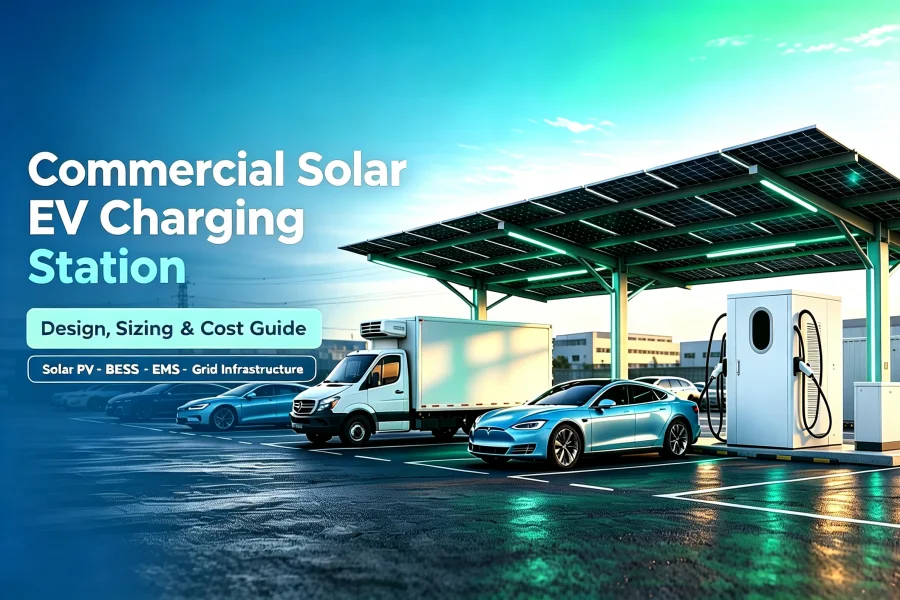
As electric vehicle adoption continues to grow, businesses and fleet operators are facing a new challenge: how to provide high-power EV charging without placing excessive demand on the electrical grid.
Installing several DC fast chargers can significantly increase a site’s peak power demand. In many commercial and fleet applications, the existing transformer or utility connection may not have enough capacity to support simultaneous high-power charging.
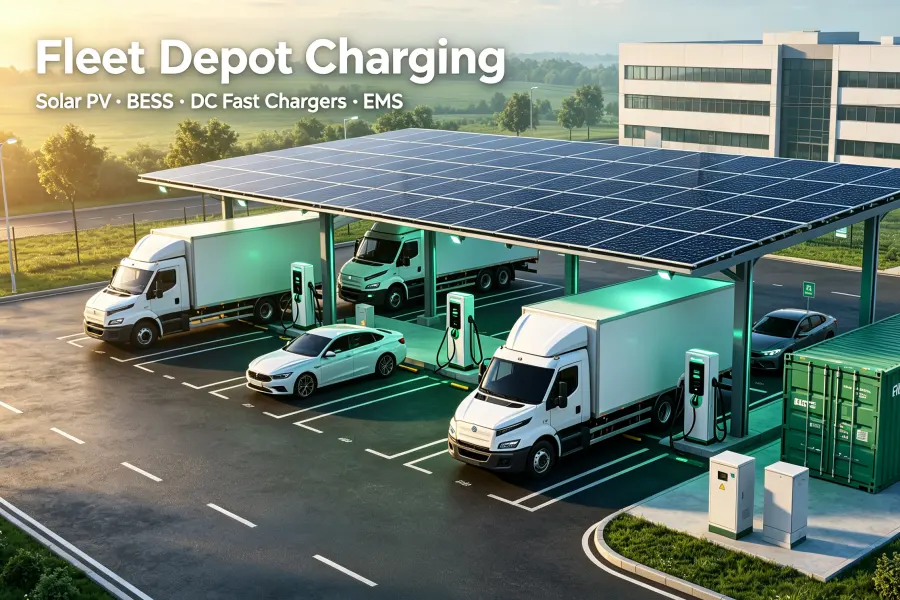
A commercial solar EV charging station with battery storage provides an integrated approach by combining:
Solar PV + Battery Energy Storage System (BESS) + EV Chargers + EMS + Grid Infrastructure
Solar power can provide renewable energy for EV charging, while battery storage can capture excess solar generation and provide additional power when charging demand exceeds the available grid capacity.
An Energy Management System (EMS) coordinates these resources to control power flow, manage charging loads, reduce peak demand, and optimize the use of available energy.
This guide explains how to evaluate, design, size, and purchase a commercial solar EV charging system with battery storage, including EV charger power, solar PV capacity, BESS sizing, grid capacity, transformer requirements, system architecture, project costs, and supplier selection.
What Is a Commercial Solar EV Charging Station?
A commercial solar EV charging station is an EV charging infrastructure system designed for businesses, fleets, parking facilities, logistics centers, industrial sites, and public charging locations.
Unlike a conventional charging station that relies primarily on the utility grid, a solar-integrated system adds photovoltaic generation to the site’s energy infrastructure.
A more advanced configuration combines solar PV with battery storage and an EMS.
A typical system may include:
- Solar PV panels
- PV inverter
- Battery Energy Storage System (BESS)
- Power Conversion System (PCS)
- AC EV chargers
- DC fast chargers
- Transformer
- Switchgear
- Energy meters
- Energy Management System (EMS)
- Charging management software
- Grid connection
- Monitoring and communication systems
The basic energy relationship can be represented as:
Solar PV + Grid + BESS → EV Chargers
The EMS manages the interaction between these energy sources and the charging loads.
Typical Energy Flow
During periods of strong solar generation:
Solar PV → EV Chargers
If solar generation exceeds the immediate charging demand:
Solar PV → BESS
When charging demand increases:
Solar PV + Grid + BESS → EV Chargers
During low-cost electricity periods, the system may also charge the battery from the grid, depending on the project’s operating strategy and local electricity tariff.
This makes the system more than an EV charging station. It becomes an integrated commercial energy infrastructure system.
Why Combine Solar PV, BESS and EV Charging?
The main reason to integrate solar and battery storage with EV charging is power management.
A commercial EV charging site can have a much higher instantaneous power requirement than the site’s existing building load.
For example, consider a fleet depot with:
The total installed charging capacity is:
480 kW
If the facility’s existing grid connection can provide only approximately:
300 kW
there is a potential power gap of:
480 kW − 300 kW = 180 kW
A conventional solution may require additional grid capacity, a transformer upgrade, or other electrical infrastructure investment.
A properly sized BESS can potentially provide part of this additional power during peak charging periods.
For example:
Grid: 300 kW
BESS: up to 180 kW
The combined available power can potentially support approximately:
480 kW
subject to the actual site load, BESS power rating, PCS rating, battery state of charge, charging demand, and system operating limits.
The purpose is not necessarily to operate every charger at maximum power continuously.
Instead, the EMS dynamically manages available power according to real-time conditions.
How Battery Storage Supports High-Power EV Charging
Battery storage can provide several functions in a commercial EV charging system.
1. Peak Shaving
The EMS can establish a maximum grid import limit.
For example:
Grid Import Limit = 300 kW
If EV charging demand rises above that threshold, the BESS can discharge to provide additional power.
The system can therefore operate approximately as:
Grid Power + BESS Power = EV Charging Demand
while attempting to keep grid demand within the predefined limit.
2. Solar Energy Storage
Solar generation does not always match EV charging demand.
For example, solar production may be high around midday while many vehicles may arrive later in the afternoon.
Instead of exporting or curtailing excess solar generation, the system can use:
Solar PV → BESS
and later:
BESS → EV Chargers
This can improve the utilization of the site’s renewable energy.
3. Energy Time Shifting
Depending on the local electricity tariff, the BESS can potentially charge during lower-cost periods and discharge during higher-cost or higher-demand periods.
This strategy may help improve energy cost management, although the actual economic benefit depends on local electricity rates, demand charges, battery cost, cycling requirements, and project conditions.
4. Grid Capacity Optimization
For sites with limited grid capacity, BESS can provide additional flexibility.
Instead of designing the electrical infrastructure solely around the maximum theoretical charging capacity, the project can evaluate how much charging power can be supported through a combination of:
Grid + Solar + BESS + Load Management
This does not eliminate the need for utility approval or electrical engineering analysis, but it can provide another option for managing high-power charging demand.
Commercial Solar EV Charging System Architecture
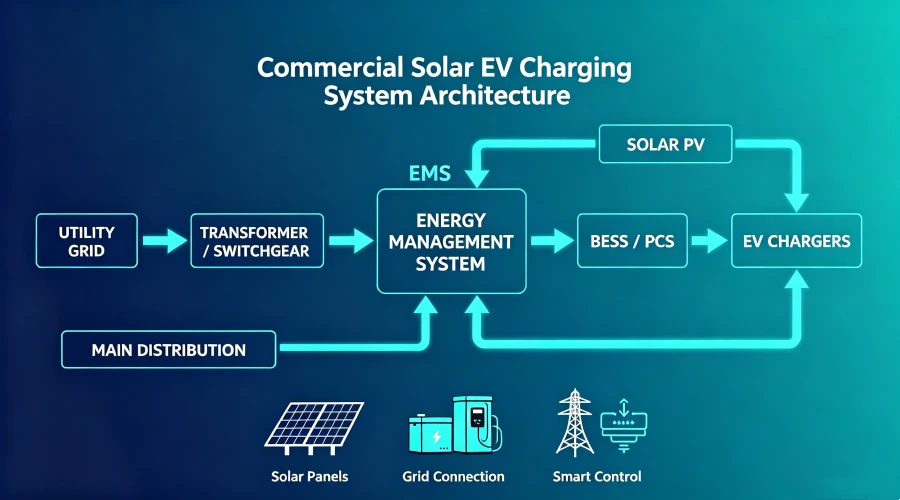
A typical grid-connected system can be structured as follows:
UTILITY GRID
↓
TRANSFORMER / SWITCHGEAR
↓
MAIN DISTRIBUTION
↓
ENERGY MANAGEMENT SYSTEM
↙ ↓ ↘
SOLAR PV — BESS / PCS — EV CHARGERS
The actual architecture depends on the project.
A larger commercial charging hub may include:
- Medium-voltage utility connection
- MV/LV transformer
- Main switchboard
- PV inverter
- Battery PCS
- BESS cabinets or containers
- DC fast chargers
- AC chargers
- Energy meters
- Protection devices
- EMS
- Charging management system
- Network communication
- Remote monitoring
For larger fleet or industrial projects, the system can also form part of an integrated EV charging microgrid.
What Does the EMS Do?
The Energy Management System is the control layer that coordinates the site’s energy resources.
The EMS can monitor information such as:
- Grid power
- Solar generation
- Battery state of charge
- Battery charging/discharging power
- EV charging demand
- Building load
- Electricity tariffs
- Charging schedules
Based on these inputs, the EMS can determine how power should be allocated.
For example:
Solar Generation Is High
Solar → EV Chargers
If there is excess solar:
Solar → BESS
EV Charging Demand Increases
Solar + Grid + BESS → EV Chargers
Grid Demand Approaches the Site Limit
BESS → EV Chargers
Low-Tariff Period
Depending on the operating strategy:
Grid → BESS
This coordinated control is particularly valuable when several high-power chargers operate at the same site.
How to Size a Commercial Solar EV Charging Station
There is no universal system size for a commercial solar EV charging station.
The correct design depends on the actual site and charging profile.
The main factors include:
- Number of EVs
- Vehicle battery capacity
- Daily mileage
- Daily charging energy
- Charging schedule
- Charger power
- Simultaneous charging demand
- Existing building load
- Grid capacity
- Transformer capacity
- Solar resource
- Available PV area
- Electricity tariff
- Demand charges
- Battery operating strategy
- Future EV growth
The first step should therefore be to understand the site load profile.
Step 1: Determine EV Charging Energy Demand
Start with how much energy the vehicles actually need.
For example:
10 EVs per day
with an average charging requirement of:
60 kWh per vehicle
Estimated daily EV energy demand:
10 × 60 kWh = 600 kWh/day
This provides a starting point for estimating the required energy supply.
However, the calculation should also consider:
- Weekday demand
- Weekend demand
- Seasonal variations
- Fleet schedules
- Vehicle arrival times
- Vehicle departure times
- Battery state of charge
- Daily mileage
- Future fleet expansion
For fleet applications, actual operational data can significantly improve system sizing accuracy.
Step 2: Determine Required EV Charger Power
The next question is:
How quickly must the vehicles charge?
Charger power should be selected according to the charging window rather than simply choosing the highest available power.
AC EV Charging
Typical applications include:
- Offices
- Hotels
- Workplaces
- Commercial parking
- Long-duration parking
AC charging can be suitable when vehicles remain parked for several hours.
DC Fast Charging
DC charging is better suited to applications where vehicles need to receive a significant amount of energy in a shorter period.
Commercial DC charging systems may include:
- 30 kW
- 60 kW
- 120 kW
- 180 kW
- 240 kW
- 360 kW+
The appropriate power level depends on vehicle capability, charging time, utilization, site power availability, and future requirements.
Step 3: Calculate Maximum Site Power Demand
A common mistake is to calculate the project only from the charger nameplate ratings.
For example:
4 × 120 kW chargers = 480 kW
But this does not necessarily mean that the site will continuously consume 480 kW.
Actual charging demand depends on:
- Number of vehicles connected
- Vehicle SOC
- Vehicle charging capability
- Simultaneous charging
- Charging schedules
- Dynamic power allocation
- EMS control
- BESS support
Therefore, the project should distinguish between:
Installed Charging Capacity
and
Expected Maximum Simultaneous Charging Demand
This distinction is important when evaluating grid capacity and BESS requirements.
Step 4: Evaluate Existing Grid and Transformer Capacity
Before purchasing high-power chargers, evaluate the site’s existing electrical infrastructure.
Important information includes:
- Utility service voltage
- Transformer rating
- Main switchboard capacity
- Existing peak demand
- Available electrical capacity
- Building load profile
- Utility interconnection requirements
- Future expansion capacity
For example:
A facility may have a:
500 kVA transformer
but already consume significant power for its existing operations.
Adding several 120 kW or 180 kW DC chargers without evaluating the existing load could exceed the available capacity.
This is why commercial EV charging should be approached as an electrical infrastructure project, rather than simply a charger procurement project.
Step 5: Size the Solar PV System
Solar PV capacity depends on the amount of energy the site wants to generate and how that energy will be used.
Important factors include:
- Daily EV charging demand
- Solar irradiation
- Available rooftop area
- Solar carport area
- PV system losses
- Inverter efficiency
- Charging schedule
- Battery charging requirements
- Desired renewable-energy contribution
- Future charging demand
Simplified Example
Suppose the site requires:
1,000 kWh/day
and the estimated average solar yield is:
4 kWh/kWp/day
A simplified preliminary calculation is:
1,000 ÷ 4 = 250 kWp
This provides an initial estimate.
The final PV size may need to be larger or smaller depending on:
- Seasonal solar production
- Weather
- System losses
- Battery charging
- Solar curtailment
- Site load profile
- Available installation area
- Required renewable-energy percentage
A professional project design should use site-specific solar data rather than relying only on a simple annual average.
Step 6: How to Size the BESS
BESS sizing requires two separate calculations:
Power — kW
and
Energy — kWh
These represent different characteristics of the battery system.
BESS Power
BESS power determines how much instantaneous power the battery can provide.
For example:
200 kW BESS
means the system is designed around approximately 200 kW of discharge power, subject to the PCS and battery operating limits.
BESS Energy
BESS energy capacity determines how much energy can be stored.
For example:
400 kWh BESS
provides approximately 400 kWh of nominal energy storage before accounting for usable SOC range and other system losses and limitations.
Both values are important for commercial EV charging.
Read More:Level 3 EV Charger Explained: Complete Guide to DC Fast Charging Stations in 2026
BESS Sizing Example for Peak Shaving
Suppose:
Grid capacity = 300 kW
and:
Maximum charging demand = 480 kW
The theoretical power gap is:
480 − 300 = 180 kW
If the BESS must provide this additional power for one hour:
180 kW × 1 hour = 180 kWh
If the support period is two hours:
180 kW × 2 hours = 360 kWh
However, the actual battery size should not simply be set to 180 kWh or 360 kWh.
The design should also consider:
- Usable SOC range
- PCS efficiency
- Battery round-trip efficiency
- Battery degradation
- Temperature
- Reserve SOC
- Required operating margin
- Charging/discharging limits
- Expected cycling frequency
Therefore:
BESS Power ≠ BESS Energy Capacity
Both must be sized according to the site’s actual operating strategy.
Solar + BESS + EV Charging vs. Grid-Only Charging
A BESS is not required for every solar EV charging project.
It becomes particularly attractive when the site has:
- High DC charging power
- Limited grid capacity
- Significant peak demand
- High electricity demand charges
- Large solar generation
- Variable charging demand
- Fleet charging peaks
- Future charging expansion
Commercial Solar EV Charging Station Cost
The total cost of a commercial solar EV charging project depends on the complete system rather than the EV charger alone.
Typical cost categories include:
The largest cost variables are often related to site infrastructure.
For example, a charging project may have relatively affordable EV chargers but require significant investment in:
- Transformer upgrades
- Distribution equipment
- Long cable runs
- Civil works
- Utility interconnection
- Site construction
Therefore, comparing suppliers purely on charger price can be misleading.
A commercial buyer should compare the total system cost and expected operating performance.
How Much Does a Commercial EV Charging Station Cost?
There is no universal price for a commercial EV charging station.
A small workplace charging installation and a high-power fleet charging depot can have completely different project costs.
The final investment depends on:
- Charger quantity
- Charger power
- AC/DC configuration
- Connector standards
- Solar PV capacity
- BESS power
- BESS energy capacity
- PCS
- EMS
- Transformer
- Switchgear
- Cable length
- Civil construction
- Utility connection
- Installation
- Software
- Permitting
- Local regulations
- Project location
For this reason, commercial customers should request a project-specific quotation.
A supplier should ideally evaluate the site’s:
Charging Load + Grid Capacity + Solar Potential + BESS Requirement
before recommending the final equipment configuration.
Do You Need a Transformer Upgrade for EV Charging?
This is an important question for high-power charging projects.
Suppose a commercial facility currently has:
250 kVA transformer capacity
and wants:
2 × 120 kW DC chargers
The charger capacity alone is:
240 kW
But the building already has its own electrical load.
If the combined demand exceeds the available transformer capacity, an upgrade may be required.
However, the final requirement depends on:
- Actual building demand
- Simultaneous charging
- Charger utilization
- Dynamic load management
- Solar generation
- BESS support
- Utility requirements
A BESS may help manage peak demand, but it does not automatically eliminate the need for a transformer upgrade.
The project should therefore be evaluated using the actual site load profile and utility requirements.
How Dynamic Load Management Works
Dynamic load management allows the charging system to distribute limited electrical power among multiple vehicles.
For example:
4 × 120 kW chargers
have:
480 kW total installed capacity
but the site may have only:
300 kW available for EV charging
The EMS or charging management system can dynamically allocate the available power.
For example:
Vehicle A → 100 kW
Vehicle B → 80 kW
Vehicle C → 70 kW
Vehicle D → 50 kW
Total:
300 kW
The distribution can change continuously according to:
- Vehicle SOC
- Charging priority
- Departure time
- Fleet schedule
- Available grid power
- Solar production
- BESS SOC
- Site load
This can improve the utilization of existing infrastructure without requiring every charger to operate at maximum output simultaneously.
Commercial Applications
Fleet Depots
Fleet charging is one of the strongest applications for integrated solar + BESS + EV charging.
Potential users include:
- Delivery fleets
- Logistics companies
- Electric vans
- Service vehicles
- Municipal fleets
- Corporate fleets
- Commercial trucks
Fleet depots often have predictable vehicle schedules, making it easier to optimize charging with EMS and BESS.
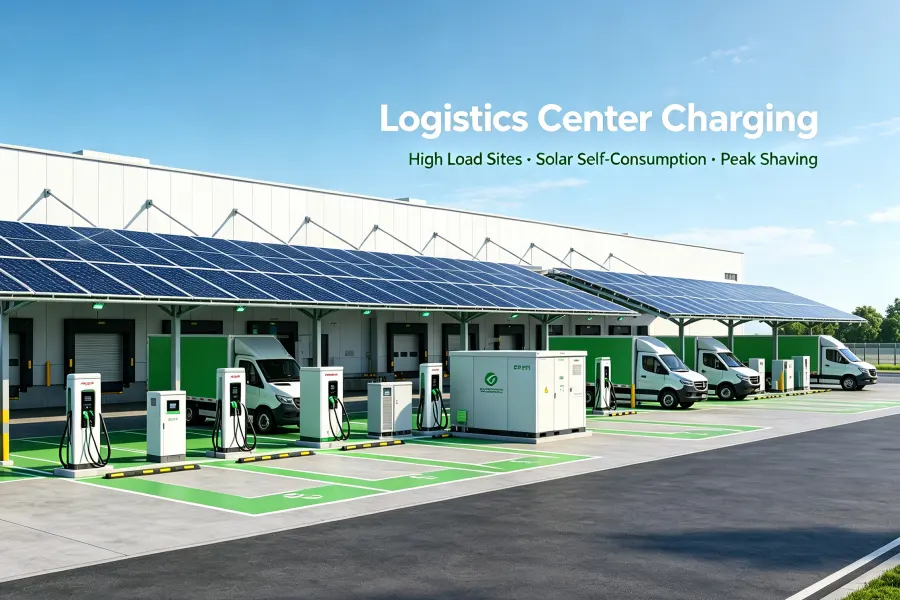
Logistics Centers
Logistics centers may have both:
High building electricity demand
and
High EV charging demand
An integrated system can coordinate:
Building Load + Solar PV + BESS + EV Charging
instead of treating EV charging as an isolated load.
Commercial Parking
Shopping centers, office buildings, hotels and mixed-use developments can integrate:
Solar Carport + EV Charging + BESS
to create a combined parking and energy infrastructure.
Highway Charging Hubs
Highway charging locations may require multiple high-power DC chargers.
For these projects, available grid capacity can become a major design consideration.
A combination of:
High-Power DC Charging + BESS + Solar PV + EMS
can provide a flexible architecture for high-demand charging locations.
Industrial Facilities
Industrial facilities may already have substantial electrical infrastructure.
Solar PV and BESS can be integrated with EV charging while the EMS coordinates the overall site’s energy flow.
This can help prevent EV charging from creating uncontrolled additional peaks.
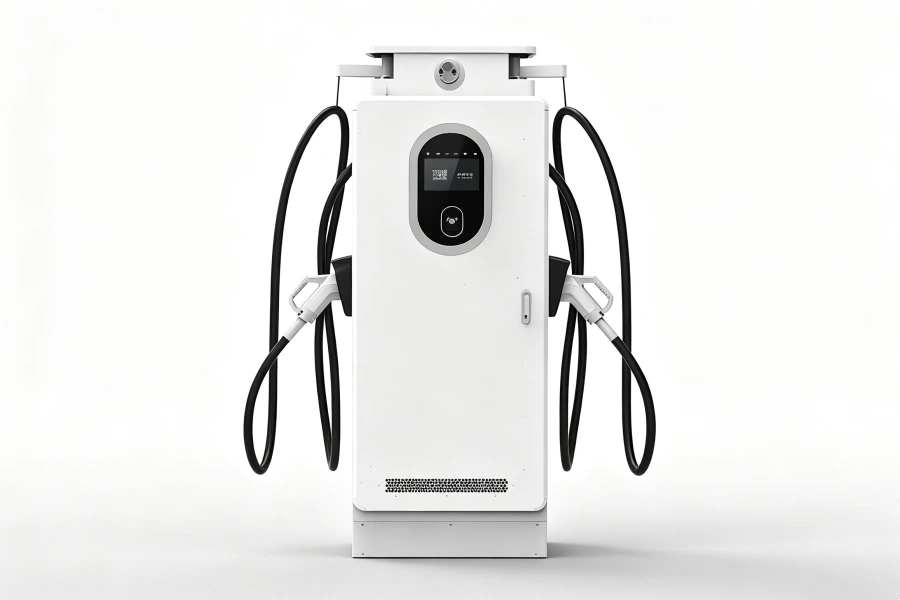
What EV Charger Power Should a Business Choose?
Higher power is not automatically better.
The charger should be selected according to:
Vehicle + Charging Window + Energy Requirement + Grid Capacity + Future Demand
7–22 kW AC
Best suited for:
- Workplace charging
- Offices
- Hotels
- Long-duration parking
30–60 kW DC
Suitable for:
- Commercial parking
- Retail
- Smaller fleets
- Medium-duration charging
120–180 kW DC
Suitable for:
- Fleet depots
- Commercial charging hubs
- High-utilization sites
240–360 kW+ DC
Suitable for:
- Highway charging
- High-throughput charging hubs
- Large fleet depots
- High-power commercial applications
The final selection should also consider the maximum charging power supported by the target vehicles.
Technical Requirements for Commercial EV Charging
Commercial buyers should evaluate more than charger power.
Charging Standards
Depending on the destination market and vehicle population, requirements may include:
- CCS1
- CCS2
- NACS
- Type 2 AC
- Other regional standards
The connector configuration should match the target vehicles and local market.
Communication and Network Integration
Commercial charging projects may require:
- OCPP
- Remote monitoring
- Backend integration
- Charging management
- Dynamic load management
- Energy management integration
The exact communication requirements depend on the charging network architecture.
Smart Charging
Commercial systems should consider capabilities such as:
- Dynamic load balancing
- Power sharing
- Scheduled charging
- Remote configuration
- Charging priority
- Demand management
- Energy monitoring
ISO 15118 and Plug & Charge
For projects targeting advanced EV charging functionality, ISO 15118 capabilities may be relevant.
Depending on the vehicle, charger and software ecosystem, features can include:
- Vehicle identification
- Plug & Charge
- Smart charging
- Advanced vehicle-to-grid functionality where supported
The exact functionality should always be confirmed between the charger, vehicle and backend system.
How to Choose a Commercial Solar EV Charging Supplier
Selecting the right supplier is especially important for projects that combine multiple technologies.
A supplier should ideally understand:
EV Charging + Solar + BESS + EMS + Electrical Infrastructure
rather than only one component.
1. EV Charger Portfolio
Check whether the supplier offers the required:
- AC chargers
- DC fast chargers
- High-power chargers
- Connector configurations
- Charging power levels
2. BESS Integration
Ask whether the supplier can integrate:
Battery + PCS + EMS + EV Chargers
into one coordinated system.
3. Solar Integration
The supplier should understand how PV generation interacts with:
- EV charging
- Battery charging
- Grid power
- EMS control
4. EMS Capability
The EMS should be capable of coordinating:
- Grid import
- Solar generation
- Battery charging/discharging
- EV charging
- Peak shaving
- Dynamic load management
5. Communication
Check compatibility with the project’s:
- Charging network
- Backend software
- OCPP requirements
- Energy management platform
- Remote monitoring system
6. Certification and Compliance
The required certification depends on the project market.
For European, North American and other international projects, buyers should confirm the applicable:
- Electrical safety standards
- EMC requirements
- Grid connection requirements
- Local installation codes
- Product certifications
Certification requirements should be verified for the exact product configuration and destination market before procurement.
7. Engineering Support
For larger projects, the supplier should be able to provide more than hardware.
Useful capabilities include:
- System architecture
- Electrical design support
- Load analysis
- BESS sizing
- PV sizing
- EMS configuration
- Charger configuration
- Communication integration
- Technical documentation
8. After-Sales Support
Important considerations include:
- Warranty
- Spare parts
- Remote diagnostics
- Technical support
- Firmware updates
- Maintenance support
- Local or regional service capability
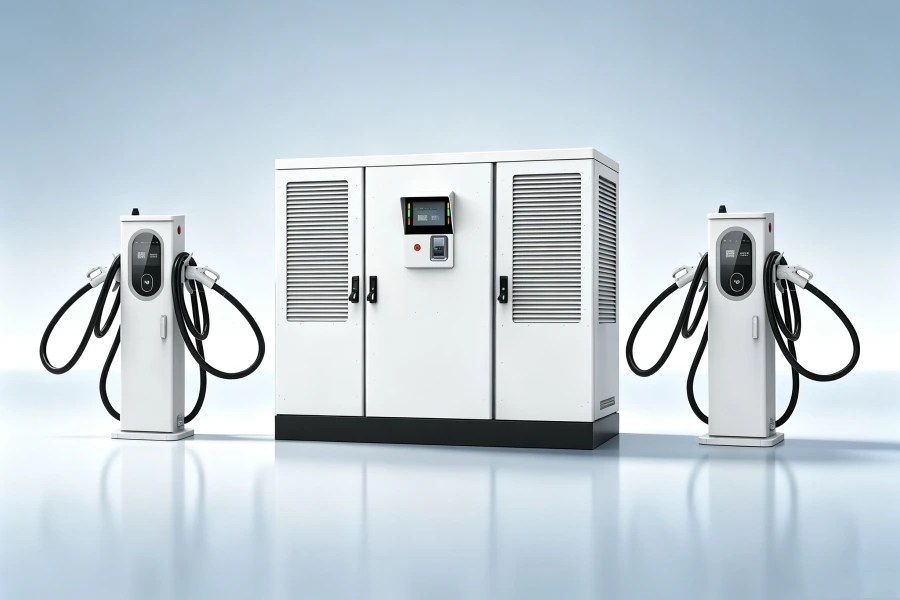
Commercial Solar EV Charging System Design Example
Consider a hypothetical electric fleet depot.
Project Requirements
4 × 120 kW DC fast chargers
Total installed charging capacity:
480 kW
Existing grid capacity:
300 kW
Potential solar capacity:
250–300 kWp
BESS:
Sized according to the required peak-shaving power and duration
EMS:
Required
The system could operate using the following strategy.
Daytime — Solar Generation
Solar → EV Chargers
Excess generation:
Solar → BESS
High Charging Demand
Solar + Grid + BESS → EV Chargers
The EMS attempts to maintain the predefined grid import limit.
Evening Charging
If sufficient battery energy is available:
BESS → EV Chargers
Otherwise:
Grid → EV Chargers
Low-Tariff Period
Depending on the local electricity tariff:
Grid → BESS
The battery can then be used during periods when charging demand or electricity costs are higher.
This example illustrates why the system should be designed around the complete site energy profile rather than charger capacity alone.
What Information Should You Provide When Requesting a Quote?
The quality of a commercial quotation depends heavily on the information provided to the supplier.
Before requesting a proposal, prepare the following information whenever possible.
Project Information
- Project country
- Project type
- Site location
- Installation timeline
- New construction or existing site
EV Charging Requirements
- Number of vehicles
- Vehicle type
- Number of chargers
- Required charger power
- Daily charging sessions
- Estimated energy per vehicle
- Charging schedule
- Future expansion requirements
Electrical Information
- Utility voltage
- Transformer rating
- Existing peak demand
- Available grid capacity
- Main switchboard capacity
- Electrical single-line diagram
Solar Information
- Available roof area
- Solar carport area
- Desired PV capacity
- Renewable-energy target
Battery Information
- Required peak-shaving power
- Desired backup capability
- Target discharge duration
- Preferred battery capacity, if known
Commercial Information
- Target project budget
- Expected installation date
- Procurement quantity
- Required certifications
- Delivery destination
If some information is not available, a supplier can often begin with a preliminary design based on the available project data.
Why System-Level Design Matters
One of the biggest mistakes in commercial EV charging procurement is selecting the charger first and solving the rest of the infrastructure later.
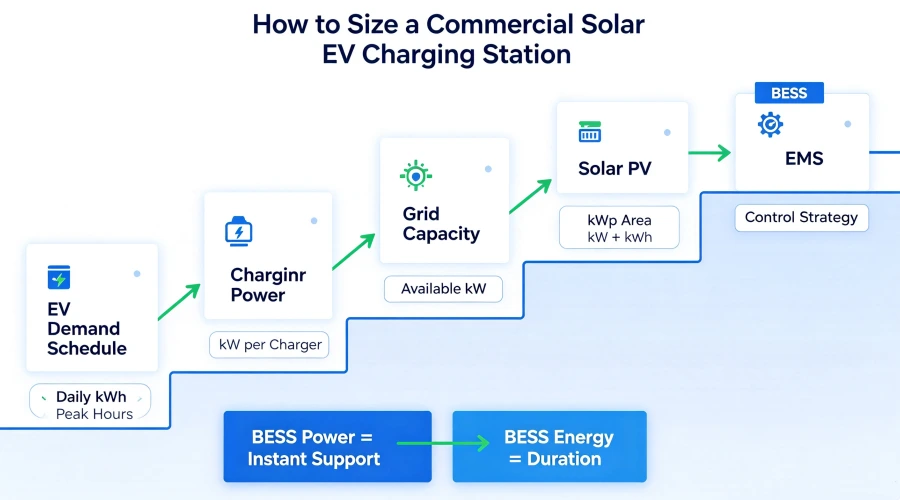
A better approach is:
EV Demand
↓
Charging Schedule
↓
Charger Power
↓
Grid Capacity
↓
Solar PV
↓
BESS
↓
EMS
↓
Electrical Infrastructure
↓
Future Expansion
This approach can help avoid situations where the selected charging capacity is incompatible with the site’s electrical infrastructure.
It can also help identify opportunities to optimize the overall system.
The goal should not simply be:
Install more chargers.
The goal should be:
Deliver the required charging energy at the required speed while using the site’s available energy infrastructure efficiently.
Key Takeaways
A commercial solar EV charging station with battery storage can integrate several energy technologies into one coordinated system:
Solar PV + BESS + PCS + EMS + EV Chargers + Grid
The most important design considerations are:
1. Start With Charging Demand
Understand how many vehicles need charging and how much energy they require.
2. Select Charger Power According to the Charging Window
Do not automatically choose the highest-power charger.
3. Evaluate Existing Grid Capacity
Determine whether the transformer and utility connection can support the planned charging load.
4. Size Solar PV According to Energy Demand
Consider solar production, available space and the desired renewable-energy contribution.
5. Size BESS by Both kW and kWh
Battery power determines instantaneous support.
Battery energy capacity determines how long that support can be provided.
6. Use EMS for Intelligent Power Management
EMS can coordinate grid, solar, BESS and EV charging.
7. Evaluate Total Project Cost
The charger price is only one part of the complete project.
8. Choose a System-Level Supplier
For commercial projects, supplier engineering capability can be as important as hardware specifications.
Conclusion
The future of commercial EV charging is not simply about installing more charging stations.
As EV fleets grow and charging power increases, businesses need to consider the relationship between:
EV Charging Demand + Grid Capacity + Solar Generation + Battery Storage + Energy Management
An integrated commercial solar EV charging station with BESS can provide a flexible approach for fleet depots, logistics centers, commercial properties, industrial facilities, parking facilities, and high-power charging hubs.
The ideal system depends on the project’s specific requirements.
There is no universal combination of:
kW + kWh + kWp + Number of Chargers
that works for every site.
A practical design process is:
Vehicle Demand
→ Charging Schedule
→ Charger Selection
→ Grid Capacity Analysis
→ Solar PV Sizing
→ BESS Power & Energy Sizing
→ EMS Strategy
→ System Architecture
→ Equipment Selection
→ Project Proposal
For commercial buyers, this system-level approach provides a more reliable basis for equipment procurement than comparing EV charger prices alone.
Request a Customized Commercial EV Charging System Proposal
Planning a commercial, fleet, industrial, or high-power EV charging project?
Energy Splendor can support integrated system solutions combining:
- Commercial AC EV Chargers
- DC Fast Chargers
- Solar PV
- Battery Energy Storage Systems
- PCS
- EMS
- Grid-connected infrastructure
- EV charging microgrid systems
To help us evaluate your project, provide:
Project Location:
Project Type:
Number of EVs:
Number of Chargers:
Required Charger Power:
Existing Grid / Transformer Capacity:
Solar PV Requirement:
BESS Requirement:
Expected Installation Date:
Additional Requirements:
Get a Customized System Proposal
Our team can evaluate the required combination of EV charging capacity, solar PV, battery storage, EMS and grid infrastructure and provide a preliminary system recommendation based on your project requirements.