



















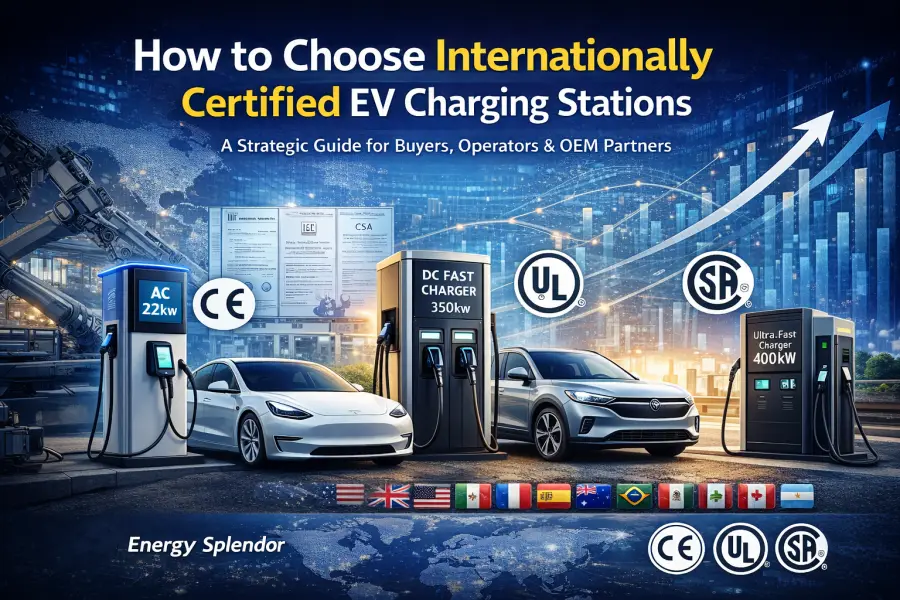
Introduction: Certification Is No Longer Optional
As EV charging infrastructure expands globally, certification and compliance have become critical factors in charger selection. For project developers, charging network operators, fleet owners, and distributors, choosing internationally certified Estaciones de recarga para vehículos eléctricos directly impacts safety, project approval, long-term reliability, and market access.
In 2026, EV charger certification is no longer a “nice-to-have” — it is a mandatory requirement for global deployment.
This guide explains how to choose the right EV charging stations based on international standards, regional regulations, and real-world project needs, while avoiding costly compliance mistakes.
1. Why EV Charger Certification Matters in Global Projects
Certified EV charging stations ensure:
Electrical safety for users and vehicles
Compliance with local grid and building regulations
Smooth customs clearance and project approval
Long-term reliability and lower operational risk
For international buyers, uncertified or partially compliant chargers can lead to:
Project delays
Installation rejection
Legal and insurance issues
Increased maintenance costs
That is why professional buyers increasingly prefer working with certified EV charging station manufacturers rather than unverified suppliers.
2. Core International Standards for EV Charging Stations
2.1 IEC Standards (Global & Europe-Focused)
IEC standards form the foundation of EV charging safety and performance worldwide.
Key standards include:
IEC 61851 – General EV charging system requirements
IEC 62196 – EV charging connectors and couplers
These standards are widely accepted across Europe, the UK, Australia, Southeast Asia, and many emerging markets.
2.2 CE Certification (European Market Access)
CE certification is mandatory for EV chargers sold in the European Union.
CE-certified chargers demonstrate compliance with:
Electrical safety
Electromagnetic compatibility (EMC)
Environmental and operational requirements
Without CE certification, EV charging equipment cannot be legally sold or installed in Europe.
2.3 UL & CSA Certification (North America)
For the United States and Canada, UL and CSA certifications are critical.
UL certification is widely required by local authorities and utilities in the US
CSA certification is essential for the Canadian market
Charging stations installed without these certifications often face inspection failures and insurance issues.
2.4 Additional Compliance Requirements
Depending on region and project type, buyers may also require:
RoHS compliance
IP-rated enclosure protection
Grid compatibility testing
Communication protocol validation (OCPP, ISO 15118)
3. Matching Certification to Regional Markets
Choosing the right EV charger starts with understanding where the equipment will be installed.
North America (USA & Canada)
UL / CSA certified EV charging stations
CCS1 connector support
OCPP compatibility for network operation
Europe & UK
CE-certified chargers
CCS2 and Type 2 connectors
IEC-compliant electrical design
Australia
IEC & CE-based compliance
Type 2 and CCS2 support
Latin America (Mexico, Argentina, Brazil)
Increasing alignment with IEC and CE standards
Growing demand for certified Carga rápida de corriente continua infrastructure
Selecting region-specific certification upfront reduces risk and accelerates project deployment.
4. Certification Considerations for Different Applications
Residential & Workplace Charging
Focus on electrical safety, EMC, and enclosure protection
Certification ensures safe daily operation
Commercial & Public Charging
Level 2 + DC fast charging combination
Higher certification and testing requirements
Reliability and uptime are critical
Fleet & High-Power DC Fast Charging
High-current DC systems
Strict safety and thermal testing
Certified power modules and cooling systems are essential
5. OEM & Custom EV Charging Stations: Certification Still Applies
Customization does not mean sacrificing compliance.
Professional EV charging station factories support:
OEM branding
Power configuration customization
Connector and cable options
Software and communication customization
—all while maintaining full certification compliance.
This is especially important for distributors and project developers launching private-label charging solutions.
6. Choosing the Right EV Charging Station Manufacturer
When selecting a supplier, global buyers should look for:
Proven experience in international markets
Full certification support (CE, UL, CSA, IEC)
Factory-level manufacturing capability
OEM and wholesale supply experience
Ability to support multi-country projects
Manufacturers with global project experience significantly reduce risk and simplify large-scale deployment.
Conclusion: Certified EV Chargers Protect Your Project and Investment
As EV charging infrastructure continues to expand in 2026, certification is one of the most critical decision factors for buyers and developers. Certified EV charging stations ensure safety, regulatory compliance, and long-term performance across global markets.
Working with an experienced, internationally focused EV charging station manufacturer allows buyers to deploy infrastructure faster, safer, and with greater confidence.
About Energy Splendor
Energy Splendor is a professional EV charging station manufacturer and factory supplier, providing certified Level 2 and DC fast charging solutions for residential, commercial, fleet, and public applications. We support OEM, wholesale, and customized EV charging projects across the United States, Canada, the UK, Germany, France, Spain, Italy, Australia, Mexico, Argentina, Brazil, and global markets.