


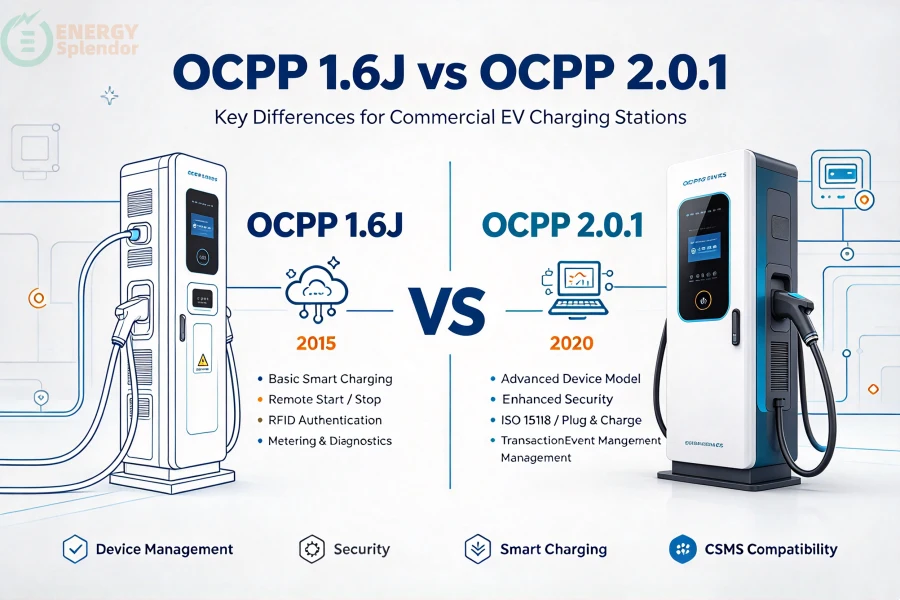
As electric vehicle charging networks continue to expand worldwide, communication between EV charging stations and charging management systems has become increasingly important. For commercial charging station operators, choosing the right communication protocol can affect network compatibility, remote management, security, and long-term operational efficiency.
Two widely used versions of the Open Charge Point Protocol (OCPP) are OCPP 1.6J and OCPP 2.0.1. Both enable communication between EV chargers and central management platforms, but they differ significantly in functionality, device management, security, and smart charging capabilities.
What is the difference between OCPP 1.6J and OCPP 2.0.1? Which version is better for commercial DC fast charging stations? And what should buyers consider before purchasing OCPP-compatible EV chargers?
This guide explains the key differences and helps charging station operators, distributors, and commercial project developers make informed purchasing decisions.
1. What Is OCPP in EV Charging?
OCPP stands for Open Charge Point Protocol. It is an open communication standard developed and maintained by the Open Charge Alliance (OCA).
OCPP establishes communication between an EV charging station and a Charging Station Management System (CSMS), allowing operators to manage charging equipment remotely.
With OCPP-compatible charging stations, operators can:
Monitor charger status and operating conditions remotely.
Start and stop charging sessions through a management platform.
Collect charging transaction and energy consumption data.
Manage RFID authorization and user access.
Monitor faults and receive diagnostic information.
Configure charging parameters remotely.
Apply smart charging and load management strategies.
One of the main advantages of OCPP is interoperability. It helps reduce dependence on proprietary communication systems and makes it easier for charging operators to manage equipment from different manufacturers.
For commercial EV charging networks, OCPP compatibility is an important consideration when selecting charging equipment and management software.
2. What Is OCPP 1.6J?
OCPP 1.6 was released in 2015 and became one of the most widely adopted communication protocols in the EV charging industry.
The letter J refers to JSON over WebSocket, which is a common implementation of OCPP 1.6. The original OCPP 1.6 specification also supports SOAP.
OCPP 1.6J provides essential communication functions for commercial AC and Estaciones de carga de corriente continua.
Its main capabilities include:
Remote start and stop of charging sessions.
Charging transaction management.
Real-time charging status monitoring.
RFID-based user authentication.
Remote configuration and diagnostics.
Firmware update management.
Smart charging and load balancing.
Meter value reporting.
For many commercial charging applications, OCPP 1.6J provides the necessary functionality to operate and manage charging stations efficiently.
It is particularly suitable for operators who already use an established CSMS platform that supports OCPP 1.6J.
Although newer protocol versions offer additional capabilities, OCPP 1.6J remains a practical choice for many charging networks because of its extensive industry adoption.
3. What Is OCPP 2.0.1?
OCPP 2.0.1 was introduced in 2020 as a major development of the OCPP standard.
Compared with OCPP 1.6J, it introduces a more advanced communication architecture with improved device management, security, transaction handling, and smart charging functions.
Entre las características principales se incluyen:
Advanced Device Management
OCPP 2.0.1 introduces a structured device model that allows charging management systems to retrieve and configure detailed information about charging station components and variables.
This improves equipment monitoring and troubleshooting, particularly for complex commercial DC fast charging systems.
Enhanced Security
OCPP 2.0.1 provides more comprehensive security mechanisms, including security profiles, certificate management, secure communication, and security event logging.
These capabilities help operators improve the protection of charging infrastructure and communication systems.
Improved Transaction Management
The transaction handling mechanism has been redesigned. OCPP 2.0.1 uses the TransactionEvent message to manage transaction-related events, improving the handling of charging sessions and associated data.
ISO 15118 Support
OCPP 2.0.1 supports communication between the charging station management system and the charging station for ISO 15118-related functions, including Plug & Charge authorization and certificate management.
Actual Plug & Charge operation also requires compatible EV hardware, charging station implementation, certificates, and backend support.
Advanced Smart Charging
OCPP 2.0.1 provides enhanced smart charging capabilities, supporting more sophisticated charging control and energy management applications.
These features make it suitable for operators planning larger, more intelligent, and more sophisticated charging networks.
4. OCPP 1.6J vs OCPP 2.0.1: Key Differences
The following table summarizes the main differences between the two protocols.
| FEATURE | OCPP 1.6J | OCPP 2.0.1 |
|---|---|---|
| Release year | 2015 | 2020 |
| Comunicación | JSON over WebSocket | JSON over WebSocket |
| Remote start/stop | Compatible | Compatible |
| Transaction management | Start/Stop Transaction | TransactionEvent |
| Device management | Basic configuration | Advanced device model |
| Diagnóstico remoto | Compatible | Enhanced monitoring |
| Carga inteligente | Basic smart charging | Advanced smart charging |
| Security | Basic security, with standardized extensions | More comprehensive security framework |
| Certificate management | Limited / extension-based | Native protocol support |
| ISO 15118 | Not included in the base specification | Compatible |
| Plug & Charge | Requires additional implementation | Supported with compatible systems |
| Display and messaging | Limitado | Enhanced support |
| Backward compatibility | Not applicable | Not backward compatible with 1.6 |
An important distinction is that OCPP 2.0.1 is not simply an upgraded software extension of OCPP 1.6J. The two versions have different message structures and implementation requirements.
Therefore, an EV charging station supporting OCPP 1.6J cannot automatically communicate with an OCPP 2.0.1 management platform.
Compatibility must be confirmed before deployment.
Read More:120kW vs 180kW vs 240kW vs 360kW DC Fast Charger: Which Is Right for Your Project?
5. Why Does OCPP Matter for Commercial DC Fast Charging Stations?
OCPP becomes particularly important when operating multiple DC fast charging stations across different locations.
For example, a commercial charging network may include 60kW, 120kW, 180kW, 240kW, and 360kW DC fast chargers.
Without a suitable communication protocol and management platform, operators may face difficulties monitoring equipment, managing charging sessions, and coordinating charging operations.
OCPP-compatible DC fast chargers help operators manage their infrastructure through a centralized platform.
Important applications include:
Recarga de flotas
Fleet operators can monitor charging sessions, track energy consumption, and manage charging schedules for multiple vehicles.
Redes de recarga pública
Charging network operators can remotely monitor charger availability, identify equipment faults, and manage user authorization.
Commercial Parking Facilities
Shopping centers, hotels, office buildings, and commercial parking operators can integrate charging stations into centralized management systems.
High-Power Charging Hubs
Large charging hubs with multiple high-power DC chargers can benefit from smart charging and coordinated power management to reduce unnecessary peak demand.
For projects involving solar generation and battery energy storage systems (BESS), OCPP can also form part of a wider energy management architecture. However, integration between OCPP, the site EMS, and power equipment requires compatible interfaces and a properly designed control system.
6. How to Choose Between OCPP 1.6J and OCPP 2.0.1?
There is no universal answer. The right choice depends on your existing charging infrastructure, management software, project requirements, and long-term development plans.
Choose OCPP 1.6J If:
Your existing CSMS platform primarily supports OCPP 1.6J.
You are developing a standard commercial charging network.
You need remote monitoring, transaction management, and basic smart charging.
You want to integrate charging stations into an established software ecosystem.
Your project does not require the advanced functions of OCPP 2.0.1.
Choose OCPP 2.0.1 If:
You are developing a new commercial charging network.
Your management platform supports OCPP 2.0.1.
Advanced device monitoring and configuration are important.
Your project requires enhanced security capabilities.
You plan to implement ISO 15118 and Plug & Charge.
You need more advanced smart charging functions.
For large commercial charging projects, it is worth considering future software requirements before selecting charging equipment. Migrating from one protocol version to another may require firmware, hardware, or backend changes.
Learn More:EV Charger Wholesale Buying Guide: MOQ, Pricing, OEM Options and Shipping from China
7. Is OCPP 2.1 the Next Step for EV Charging?
OCPP 2.1 was released in 2025 and builds on OCPP 2.0.1.
It introduces additional capabilities designed to support more advanced charging and energy management applications.
Important additions include:
ISO 15118-20 support.
Bidirectional charging and Vehicle-to-Grid (V2G).
Distributed Energy Resource (DER) control.
Improved smart charging.
Battery swapping support.
Expanded payment and authorization functions.
OCPP 2.1 is backward compatible with OCPP 2.0.1, but this does not mean that all OCPP 2.1 functions are automatically available on every OCPP 2.0.1 charger.
For commercial charging infrastructure developers, OCPP 2.1 is worth monitoring, especially for projects involving renewable energy, battery storage, and bidirectional power applications.
8. What Should Buyers Confirm Before Purchasing OCPP EV Chargers?
When purchasing commercial EV charging stations from a manufacturer, checking the protocol version alone is not enough.
Buyers should confirm the following technical details before placing an order.
1. Supported OCPP Version
Confirm whether the charger supports OCPP 1.6J, OCPP 2.0.1, or both through selectable firmware or configurations.
2. CSMS Compatibility
Provide your existing backend platform name or technical documentation to the manufacturer and request an integration compatibility check.
3. Required Functions
Confirm whether the charger supports the functions required by your project, including remote start/stop, RFID authorization, transaction records, remote diagnostics, and smart charging.
4. Security Requirements
Check supported TLS versions, authentication methods, certificate management, and other cybersecurity requirements.
5. Firmware and Upgrade Options
Ask whether firmware updates are available and whether future protocol upgrades require hardware modifications.
6. Testing and Certification
If OCPP certification is a project requirement, request the relevant certificate and verify the exact certified product model and optional functionality profiles.
It is important to understand that supporting an OCPP version does not automatically mean that every optional feature within that version is implemented or certified.
A technical compatibility test with the intended CSMS is strongly recommended before large-scale deployment.
9. Why Choose Energy Splendor for Commercial EV Charging Solutions?
Energy Splendor is a China-based EV charger manufacturer supplying commercial AC and DC charging equipment for international markets.
Our product range covers 3.5kW–900kW EV charging solutions, including portable chargers, wall-mounted AC chargers, and high-power DC fast charging stations.
For commercial charging projects, we provide DC fast charging solutions in multiple power configurations, including 60kW, 120kW, 180kW, 240kW, and 360kW.
Depending on the selected model and configuration, charging solutions can support:
CCS2 charging connectors for international markets.
OCPP communication options for charging network integration.
RFID and App-based charging authorization.
Remote monitoring and charging management.
OEM/ODM customization for distributors and project developers.
Wholesale supply and technical project support.
We understand that different charging projects have different requirements for communication protocols, charging power, connector standards, and backend integration.
Our team can help evaluate product configurations based on your project requirements.
Contact Energy Splendor to discuss your commercial EV charging requirements and request a product quotation.
10. Frequently Asked Questions (FAQs)
Q1: What is the main difference between OCPP 1.6J and OCPP 2.0.1?
OCPP 1.6J provides essential charging management functions, while OCPP 2.0.1 introduces advanced device management, improved transaction handling, enhanced security, ISO 15118 support, and more sophisticated smart charging capabilities.
Q2: Is OCPP 2.0.1 backward compatible with OCPP 1.6J?
No. OCPP 2.0.1 is not backward compatible with OCPP 1.6J. Charging stations and CSMS platforms must support compatible protocol versions to communicate correctly.
Q3: Is OCPP 1.6J still suitable for commercial EV charging stations?
Yes. OCPP 1.6J remains widely used and is suitable for many commercial charging applications, including public charging networks, fleet charging, and commercial parking facilities.
Q4: Does OCPP 2.0.1 support Plug & Charge?
Yes. OCPP 2.0.1 supports ISO 15118-related functions, including Plug & Charge authorization and certificate management. However, compatible EVs, charging stations, certificates, and backend systems are also required.
Q5: Can OCPP-compatible EV chargers connect to third-party charging management systems?
Yes, provided that the charger and management system support compatible OCPP versions and implemented functions. Integration testing is recommended before deployment.
Q6: Can one EV charger support both OCPP 1.6J and OCPP 2.0.1?
Some charging station models may support multiple protocol versions through firmware or configurable software. However, this capability is model-dependent and should be confirmed with the manufacturer.
Q7: Is OCPP required for commercial DC fast charging stations?
OCPP is not mandatory for every charging station, but it is highly useful for commercial charging networks that require centralized monitoring, remote management, and integration with third-party software platforms.
Get a Commercial EV Charging Project Quote
Looking for a reliable China EV charger manufacturer for your commercial charging project?
Energy Splendor supplies commercial AC and DC EV charging stations with multiple power configurations and communication options.
Whether you are developing a public charging network, fleet charging facility, commercial parking project, or EV charging distribution business, we can help you identify suitable charging equipment.
Contact our team today to discuss your requirements and request a commercial EV charging project quote.