

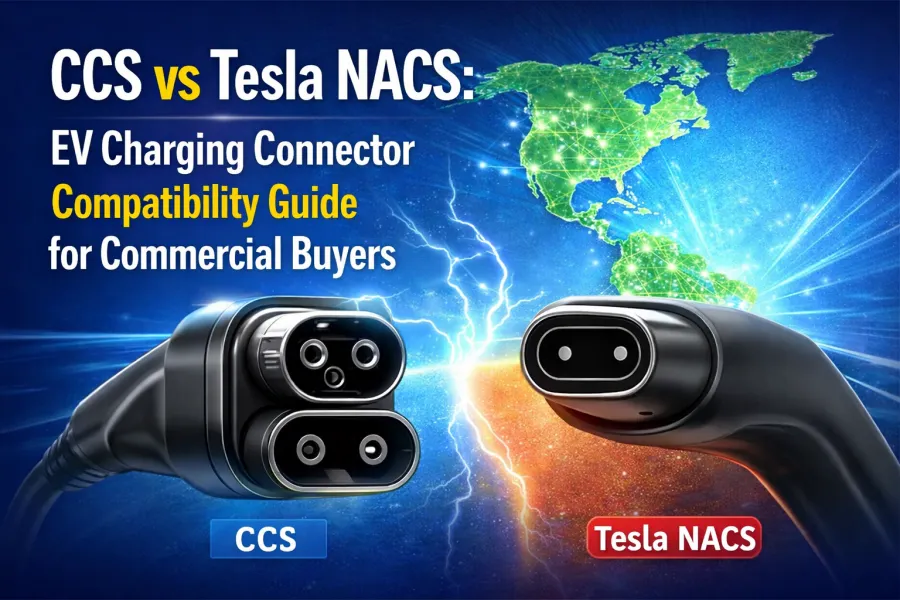
Introduction: Why EV Connector Compatibility Is a Critical Business Decision
As electric vehicle adoption continues to accelerate across North America and South America, commercial EV charging projects are expanding rapidly. Governments, fleet operators, real estate developers, and private charging networks are all investing heavily in EV charging infrastructure.
However, one technical decision has become increasingly strategic:
Which EV charging connector standard should you deploy?
Choosing between CCS (Combined Charging System) and Tesla NACS (North American Charging Standard) is no longer just a technical preference—it directly affects vehicle compatibility, station utilization, certification complexity, long-term scalability, and return on investment.
This guide is written specifically for commercial EV charging buyers, investors, and operators who need a clear, practical comparison of CCS and Tesla NACS, along with proven strategies to future-proof charging infrastructure.
1. Overview of Major EV Charging Connector Standards
Before comparing CCS and NACS, it’s important to understand the broader connector landscape.
1.1 CCS1 (Combined Charging System – North America)
-
Primary DC fast charging standard in the United States and Canada
-
Supports AC and DC charging through a single connector
-
Widely adopted by:
-
Ford
-
General Motors
-
Rivian
-
Hyundai
-
Kia
-
-
Strong support from public charging networks
1.2 CCS2 (Europe & Parts of South America)
-
Similar design to CCS1 but with different AC pin configuration
-
Common in Europe and present in some South American markets
-
Important for projects involving imported vehicles
1.3 Tesla NACS (North American Charging Standard)
-
Developed by Tesla
-
Compact, lightweight connector design
-
Increasing adoption by major automakers in North America
-
Strong presence due to Tesla’s Supercharger network
1.4 CHAdeMO (Legacy Standard)
-
Primarily used by older Nissan Leaf models
-
Gradually being phased out
-
Still relevant for certain fleet and legacy deployments
2. CCS vs Tesla NACS: Key Technical Differences
2.1 Physical Design & User Experience
CCS
-
Larger connector
-
Heavier cable, especially at high power levels
-
Familiar to most non-Tesla EV drivers
Tesla NACS
-
Smaller, lighter, and easier to handle
-
One-hand operation
-
Strong user preference in Tesla-dominated markets
From a commercial perspective, ease of use can directly affect customer satisfaction and station utilization.
2.2 Power Capability & Charging Performance
Both CCS and NACS are technically capable of:
-
High-power DC fast charging
-
Outputs exceeding 250kW
-
Supporting future ultra-fast charging scenarios
The real difference lies not in maximum power, but in:
-
Cable cooling design
-
Thermal management
-
Charger hardware quality
Connector choice alone does not guarantee faster charging—charger architecture matters more.
2.3 Communication & Protocol Compatibility
Both CCS and NACS support:
-
ISO 15118 (Plug & Charge)
-
DIN 70121 (legacy communication)
-
Modern vehicle-to-charger communication
For commercial buyers, the critical factor is ensuring:
-
Open protocol compatibility
-
Stable firmware updates
-
Interoperability with multiple vehicle brands
3. Market Adoption Trends: North America vs South America
3.1 North America
North America is experiencing a rapid shift:
-
CCS1 remains widely deployed
-
Tesla NACS is gaining momentum as:
-
Major automakers announce NACS adoption
-
Charging networks begin adding NACS connectors
-
-
Many new projects now require NACS-ready infrastructure
Key Insight:
Most commercial buyers cannot afford to choose only one connector standard.
3.2 South America
South America presents a different challenge:
-
Mixed vehicle imports from:
-
North America
-
Europe
-
China
-
-
CCS1 and CCS2 often coexist
-
Tesla vehicle penetration is lower but growing
Key Insight:
Flexibility and multi-standard support are more important than betting on a single connector.
4. Compatibility Challenges Faced by Commercial Buyers
Commercial EV charging projects frequently encounter these issues:
❌ Deploying CCS-only chargers in Tesla-heavy regions
❌ Installing Tesla-only chargers that limit public access
❌ Choosing connectors without considering certification impact
❌ Underestimating future standard changes
❌ High retrofit costs when standards evolve
These mistakes reduce:
-
Charger utilization rates
-
Customer satisfaction
-
Long-term profitability
5. Proven Solutions to Future-Proof EV Charging Infrastructure
5.1 Multi-Connector DC Fast Chargers
The most effective solution for commercial projects is deploying:
-
CCS + Tesla NACS (dual or multi-connector)
-
Optional CHAdeMO for legacy fleets
This approach ensures:
-
Maximum vehicle compatibility
-
Higher utilization
-
Longer asset lifespan
5.2 Modular Connector & Cable Design
Advanced chargers allow:
-
Connector replacement without changing the entire charger
-
Easy upgrades as standards evolve
-
Lower long-term maintenance costs
This is especially valuable for projects planned over 10–15 year lifecycles.
5.3 Software & Backend Compatibility
Hardware compatibility alone is not enough.
Commercial buyers should ensure:
-
OCPP 1.6 and OCPP 2.0.1 support
-
Compatibility with third-party charging platforms
-
Remote monitoring and diagnostics
-
Over-the-air firmware updates
Learn More:A Complete Guide to Electric Vehicle Charging Compatibility, Standards, and Solutions
6. Choosing the Right Connector Strategy by Project Type
Highway & Public Fast-Charging Stations
-
CCS + NACS recommended
-
High-power DC output (120kW–360kW)
Fleet & Logistics Charging
-
Connector choice based on fleet vehicle mix
-
Emphasis on reliability and uptime
Commercial Real Estate & Retail
-
Multi-standard support to serve diverse customers
-
User-friendly connector design
North America vs South America Projects
-
North America: NACS-ready is increasingly essential
-
South America: Multi-standard flexibility is critical
7. Certification & Compliance Considerations
Connector choice can affect certification requirements.
North America
-
UL certification
-
CSA compliance
-
NEC alignment
South America
-
INMETRO (Brazil)
-
NOM (Mexico)
-
Local grid and safety regulations
Working with a manufacturer experienced in international compliance significantly reduces approval risk.
8. Why Working with a Flexible EV Charger Manufacturer Matters
A reliable EV charger manufacturer should provide:
-
CCS and Tesla NACS support
-
Custom connector configurations
-
Modular power and cable design
-
Certification guidance
-
OEM / ODM services
-
Factory-direct pricing
This flexibility protects your investment as the market evolves.
Conclusion: CCS vs NACS Is Not an Either-Or Decision
For commercial EV charging buyers, the real question is not CCS or Tesla NACS, but:
How can I build charging infrastructure that remains compatible, compliant, and profitable over time?
The answer lies in:
-
Multi-standard support
-
Modular, scalable design
-
Open software architecture
-
Experienced manufacturing partners
🚀 Power Your EV Charging Projects with Confidence
If you are:
-
Planning a commercial EV charging deployment
-
Expanding a public or fleet charging network
-
Sourcing factory-direct EV chargers for North or South America
Energy Splendor provides reliable, future-ready EV charging solutions with:
-
CCS and Tesla NACS compatibility
-
Power ranges from 30kW to 360kW+
-
OEM / ODM customization
-
Certification and compliance support
-
Competitive factory pricing
👉 Contact Energy Splendor today to receive technical consultation, customized solutions, and commercial pricing for your next EV charging project.
Energy Splendor — your trusted partner for compatible, scalable EV charging infrastructure.