


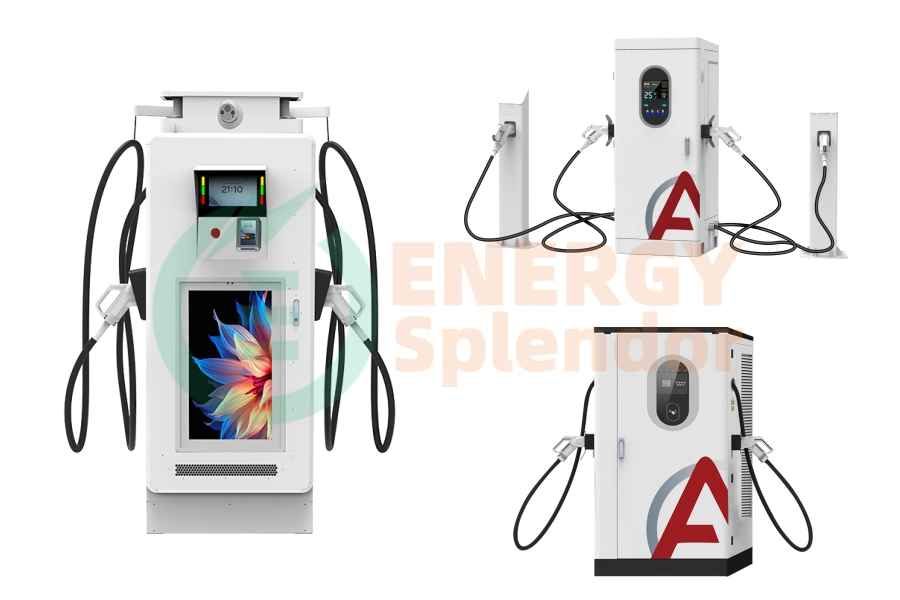
Choosing the right DC fast charger power is an important decision when developing a commercial EV charging station. Different charging projects have different requirements depending on vehicle types, daily traffic, charging time, available grid capacity and investment budgets.
For charging station operators, fleet owners and EV infrastructure developers, 120 kW, 180 kW, 240 kW e Carregadores de corrente contínua de 360 kW are common options to consider.
But which power rating is right for your project?
This guide compares four popular DC fast charger power levels and explains their typical applications.
1. 120kW vs 180kW vs 240kW vs 360kW: Quick Comparison
| CHARGER POWER | TYPICAL APPLICATIONS | RECOMMENDED PROJECTS |
|---|---|---|
| 120 kW | Commercial parking, public charging | Small and medium charging stations |
| 180 kW | Recarga pública, recarga de frotas | Growing charging networks |
| 240 kW | Highway charging, commercial fleets | High-demand charging locations |
| 360 kW | Ultra-fast charging, large fleets | Highway hubs and high-power depots |
These power ratings represent the charger’s maximum rated output. Actual charging power depends on vehicle compatibility, battery conditions, connector ratings and power distribution.
2. Which DC Fast Charger Should You Choose?
120kW DC Fast Charger
A 120kW DC charger is suitable for commercial charging locations with moderate charging demand.
As aplicações típicas incluem:
Shopping centers and commercial parking.
Hotels and business facilities.
Public charging stations.
Small and medium fleet operations.
It offers a practical balance between charging performance and infrastructure investment.
180kW DC Fast Charger
A 180kW charger provides higher charging capacity for locations with increasing EV traffic.
As aplicações típicas incluem:
Public charging networks.
Fleet depots.
Commercial transportation facilities.
High-traffic parking areas.
For operators expecting growing charging demand, 180kW can provide additional capacity without immediately moving to ultra-high-power equipment.
240kW DC Fast Charger
A 240kW charger is designed for commercial locations where faster charging and higher utilization are important.
As aplicações típicas incluem:
Highway service stations.
Commercial fleet charging.
Public fast-charging hubs.
Transportation and logistics facilities.
It is particularly relevant for projects serving vehicles capable of accepting higher DC charging power.
360kW DC Fast Charger
A 360kW DC charger is designed for high-power charging applications.
As aplicações típicas incluem:
Highway ultra-fast charging stations.
Large commercial charging hubs.
High-utilization fleet depots.
Future-oriented charging infrastructure.
However, installing a 360kW charger does not mean every vehicle will charge at 360kW. Vehicle charging capability and available electrical capacity must be considered.
3. What Factors Should You Consider Before Purchasing?
Before choosing a DC fast charger, evaluate these five factors.
1. Vehicle Compatibility
Check the maximum DC charging power supported by your target vehicles, as well as their voltage and current requirements.
2. Available Grid Capacity
Higher-power chargers require greater electrical capacity. Transformer ratings, switchgear, cables and grid connection conditions should be evaluated before installation.
3. Daily Charging Demand
Estimate the number of vehicles, average energy consumption and expected charging sessions per day.
4. Connector and Communication Standards
For international projects, confirm connector requirements such as CCS2 or CCS1. OCPP 1.6J and OCPP 2.0.1 support should also be checked against your charging management system.
5. Future Expansion
If you plan to expand your charging network, consider modular charging systems, power sharing and additional charging capacity.
4. How Much Does a Commercial DC Fast Charger Cost?
The price of a commercial DC fast charger depends on more than its rated power.
Important pricing factors include:
Charging power and configuration.
Number and type of connectors.
Power modules and electrical components.
Display, RFID and communication functions.
OCPP compatibility.
Cooling and enclosure design.
OEM/ODM customization.
Order quantity and shipping destination.
For commercial projects, remember to include installation, transformer upgrades, switchgear, cables and civil engineering in your overall budget.
To obtain an accurate quotation, provide the required power rating, quantity, connector type and destination country.
5. Choose the Right DC Fast Charger Manufacturer
Working with an experienced manufacturer helps ensure that the selected charging equipment matches your project requirements.
Energy Splendor offers commercial AC and DC EV charging products, including 120kW, 180kW, 240kW and other high-power charging options across its product portfolio.
We support international distributors, wholesalers and commercial charging projects with:
Commercial DC fast charging stations.
CCS1 and CCS2 connector options.
OEM/ODM customization.
OCPP communication options.
Product technical documentation.
Project-based product recommendations.
Whether you are developing a public charging network, fleet depot or highway charging station, selecting the right power configuration is essential.
Frequently Asked Questions
Q1: Is a 120kW DC charger suitable for commercial use?
Yes. A 120kW charger can serve commercial parking facilities, public charging stations and smaller fleet operations.
Q2: Is a 360kW charger always faster than a 240kW charger?
Not necessarily. Actual charging speed depends on the vehicle’s maximum charging power, battery conditions and charger configuration.
Q3: Can one DC charger charge two vehicles simultaneously?
Some DC chargers support dual connectors and power sharing. The available power for each vehicle depends on the charger’s design and power distribution configuration.
Q4: Which connector should I choose for European projects?
CCS2 is the common DC fast charging connector standard for European-market vehicles. Type 2 is commonly used for AC charging.
Get a Commercial EV Charging Project Quote
Looking for 120kW, 180kW, 240kW or 360kW DC fast chargers?
Contact Energy Splendor for commercial EV charging equipment, OEM/ODM cooperation and wholesale supply.
Send us your required power, connector type, order quantity and destination country. Our team can help you identify suitable products for your project.
Get a Commercial EV Charging Project Quote Today.