

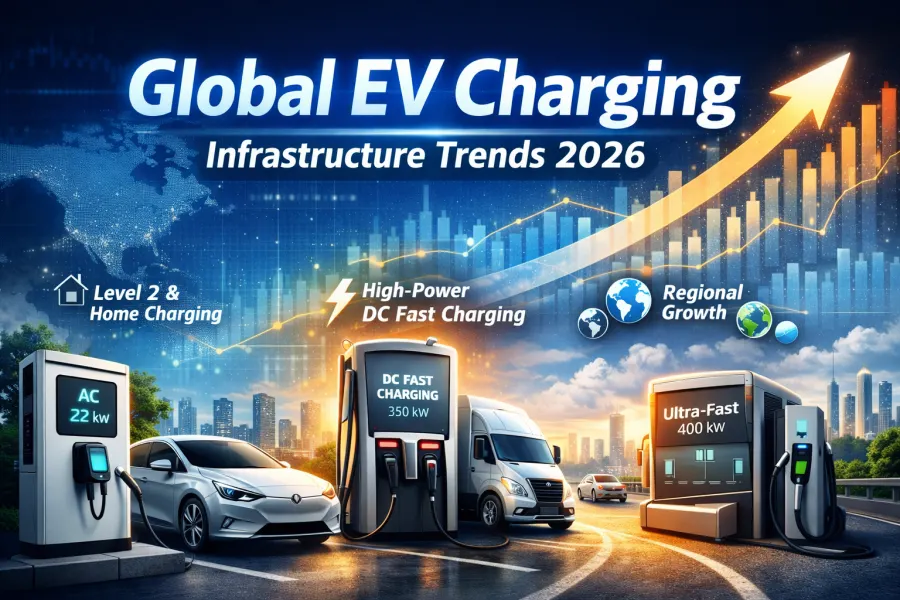
Introduction: EV Adoption Is Accelerating — Infrastructure Must Keep Up
As global electric vehicle (EV) adoption continues to accelerate, charging infrastructure has become one of the most critical pillars supporting the transition to clean transportation. By 2026, the conversation is no longer about whether EV charging infrastructure will expand, but how fast, where, and what type of charging solutions will dominate different markets.
For EV charging station manufacturers, project developers, fleet operators, and energy companies, understanding the global EV charging infrastructure trends in 2026 is essential for long-term planning, investment decisions, and technology selection.
1. Global Market Outlook: Strong Growth Through 2026 and Beyond
The global EV charging infrastructure market is entering a phase of sustained expansion driven by three key factors:
-
Rapid growth in EV sales worldwide
-
Government decarbonization policies and infrastructure incentives
-
Rising demand for faster, more reliable charging experiences
By 2026, the global EV charging infrastructure market is expected to reach tens of billions of dollars in annual value, with a double-digit compound annual growth rate (CAGR). The total number of installed charging points worldwide is projected to continue climbing sharply, moving from millions of units today toward over 10 million public and semi-public chargers before the end of the decade.
Importantly, growth is no longer limited to mature EV markets. Emerging regions are becoming major contributors, reshaping global demand patterns.
2. Key Technology Trends Shaping EV Charging in 2026
2.1 High-Power DC Fast Charging Becomes the Core Growth Driver
One of the most significant trends leading into 2026 is the rapid expansion of DC fast charging infrastructure.
While AC Level 2 chargers remain essential for residential and workplace use, DC fast chargers are increasingly prioritized for:
-
Public charging networks
-
Highway and corridor charging
-
Commercial fleets and logistics hubs
-
Urban fast-turnover locations
Charging power levels are steadily increasing from traditional 60–120 kW systems to 160 kW, 240 kW, 360 kW, and even ultra-high-power installations. This shift is driven by consumer expectations for shorter charging times and the growing number of EVs capable of accepting higher charging power.
For manufacturers, this trend emphasizes the importance of:
-
High-efficiency power modules
-
Robust thermal management (air and liquid cooling)
-
Stable operation under continuous high load
2.2 Modular and Scalable Charging Architecture
By 2026, modular charging system design is becoming the industry standard.
Instead of deploying fixed-power chargers, operators increasingly prefer modular DC charging stations that allow power to be expanded or redistributed as demand grows. This approach offers several advantages:
-
Lower initial investment
-
Easier maintenance and replacement
-
Flexible power allocation across multiple charging guns
-
Future-proof infrastructure planning
For large public and fleet projects, scalability is no longer optional—it is a core requirement.
2.3 Smart Charging, Connectivity, and Software Integration
EV charging infrastructure is evolving from standalone hardware into networked energy assets.
In 2026, smart charging capabilities are expected as standard features, including:
-
OCPP-based backend communication
-
Dynamic load management
-
Remote monitoring and diagnostics
-
User authentication and billing integration
-
Compatibility with energy management systems
Charging stations are increasingly integrated with renewable energy sources, battery storage, and smart grids, especially in commercial and utility-scale deployments.
3. Regional EV Charging Infrastructure Trends
3.1 North America: Policy-Driven Expansion and Fleet Electrification
In the United States and Canada, government infrastructure programs and private investment continue to drive EV charging deployment. Key focus areas include:
-
Interstate and highway DC fast charging corridors
-
Public charging in urban and suburban areas
-
Fleet electrification for logistics, public transit, and corporate vehicles
Fleet charging is emerging as one of the fastest-growing segments, requiring reliable, high-power, and customized charging solutions.
3.2 Europe: Dense Networks and Standardization
Europe remains a leader in charging density and regulatory alignment. By 2026, European markets emphasize:
-
Interoperability and standardization
-
High availability and uptime requirements
-
Strong preference for CCS2 DC fast charging
-
Integration with renewable energy and smart grid systems
Urban charging, workplace charging, and highway ultra-fast charging are all expanding simultaneously, creating strong demand for a wide range of charging solutions.
3.3 Asia-Pacific: Scale, Speed, and Manufacturing Strength
Asia-Pacific continues to be the world’s largest EV charging market in terms of installation volume. Growth is driven by:
-
Large-scale urban EV adoption
-
Government-backed infrastructure programs
-
Rapid expansion in emerging economies
This region also plays a central role in EV charging equipment manufacturing, supporting global supply chains with cost-effective, high-quality solutions.
3.4 Latin America, Middle East & Africa: Emerging Opportunities
While still developing, these regions represent some of the highest long-term growth potential. Infrastructure deployment is accelerating in:
-
Major metropolitan areas
-
Commercial real estate projects
-
Public transportation electrification initiatives
For manufacturers and project developers, early market entry offers significant strategic advantages.
4. Challenges Facing EV Charging Infrastructure in 2026
Despite strong growth, several challenges remain:
-
Grid capacity constraints in high-density charging locations
-
High installation and civil engineering costs
-
Variations in standards and certification requirements across regions
-
The need for long-term reliability and lifecycle cost control
These challenges increase demand for high-quality, certified, and customizable charging equipment, rather than low-cost, one-size-fits-all solutions.
5. What This Means for EV Charging Manufacturers and Partners
For EV charging equipment manufacturers like Energy Splendor, the 2026 market landscape highlights several strategic priorities:
-
Offering a complete product portfolio from AC Level 1 & Level 2 to high-power DC fast chargers
-
Supporting OEM and ODM customization for different markets and applications
-
Ensuring compliance with international standards and certifications
-
Delivering scalable, modular, and future-ready charging solutions
-
Providing reliable global supply and project support
As competition intensifies, buyers increasingly select partners based on engineering capability, manufacturing reliability, and long-term cooperation potential, not price alone.
Conclusion: 2026 Is a Defining Year for Global EV Charging Infrastructure
The year 2026 represents a critical transition point for the global EV charging industry. Infrastructure deployment is accelerating, technology is advancing rapidly, and market demand is becoming more sophisticated and diversified.
For project developers, operators, and manufacturers, success will depend on anticipating trends, adopting scalable technologies, and working with experienced charging equipment partners capable of supporting global projects.
As EV adoption continues to reshape transportation worldwide, charging infrastructure will remain at the center of this transformation.