



















Independent Power
for EV Charging Anywhere
Traditional EV charging infrastructure often depends on a stable and sufficiently sized utility grid. However, many potential charging locations are remote, have limited grid capacity or require costly electrical infrastructure upgrades.
Our off-grid EV charging systems combine renewable energy generation, battery storage and intelligent energy management to create an independent charging infrastructure.
Solar PV provides clean electricity during the day. Excess solar energy is stored in the BESS and released when solar generation is insufficient. The EMS continuously manages energy flow between solar generation, battery storage and EV charging loads.
The result is a flexible and scalable EV charging system that can operate without a conventional grid connection.
Key System Advantages
Grid-Independent Operation
Provide EV charging in locations where utility grid connection is unavailable, unreliable or economically impractical.
Solar-Powered Charging
Use solar PV as the primary energy source to generate clean electricity for EV charging.
Battery Energy Storage
Store excess solar energy and provide stable power during periods of low solar generation.
Intelligent Energy Management
Coordinate PV generation, battery charging and discharging, EV charging demand and system operating conditions.
Scalable Charging Capacity
Build systems ranging from small remote charging stations to large commercial and fleet charging hubs.
Off‑Grid Solar + BESS + EV Charging System Architecture
A complete off‑grid EV charging station integrates multiple energy and electrical components into one coordinated power system.
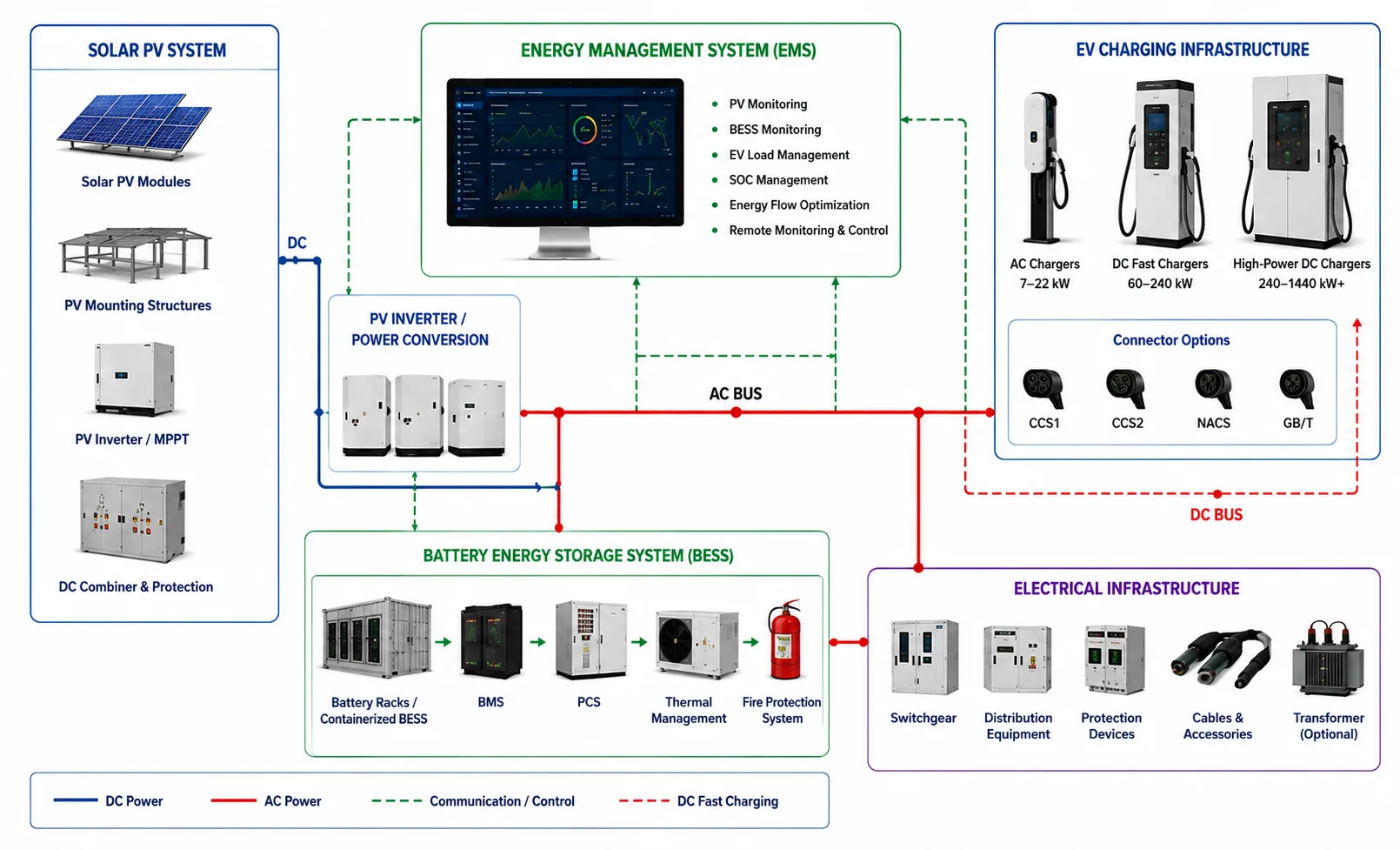
How an Off-Grid EV Charging System Works
Intelligent energy flow management ensures reliable and efficient EV charging 24/7.
01 Solar Energy | 02 Excess Solar Energy | 03 Intelligent EV | 04 Battery Energy | 05 Energy |
Applications typiques
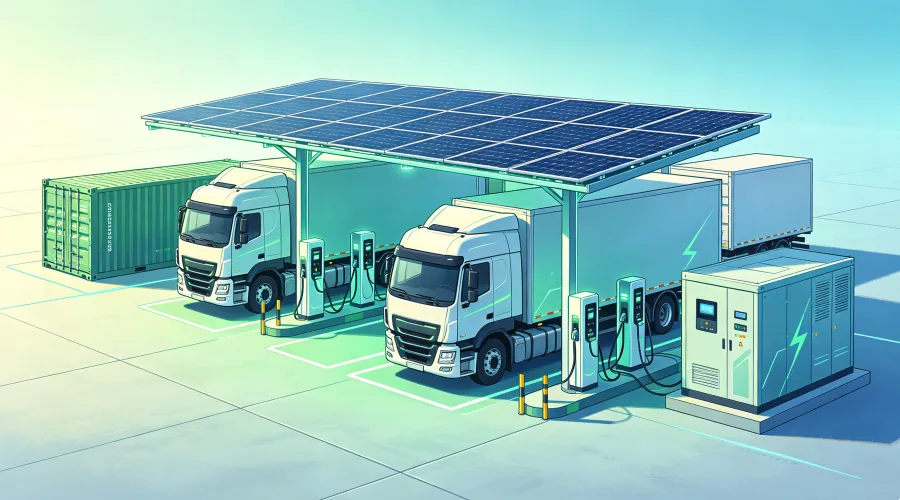
Commercial & Fleet Charging Depots
Ideal solar‑battery microgrid charging solution for commercial truck fleets and logistics depots. Supports high‑power fast charging, reduces grid stress and operational costs for heavy‑duty vehicle fleet operators.
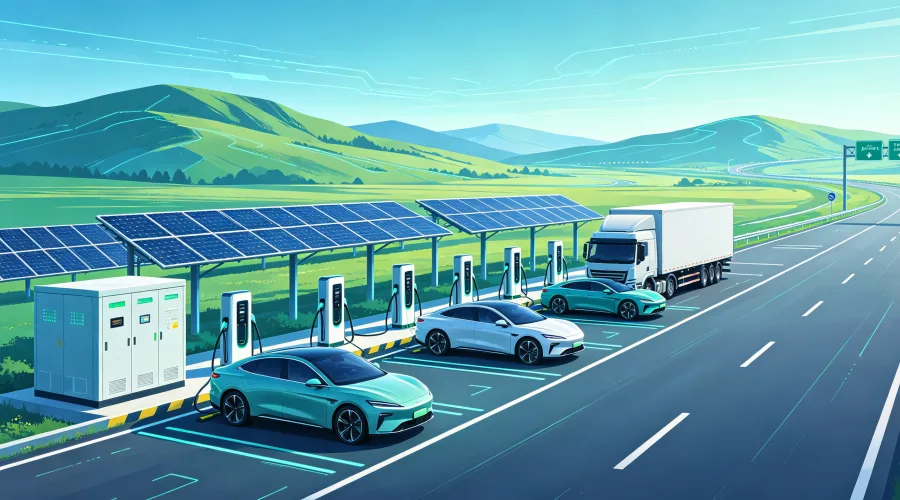
Highway & Corridor Charging Stations
Solar‑backed EV charging stations deployed along highway corridors. Leverage battery energy storage to deliver reliable fast charging for passenger cars and commercial trucks in high‑traffic roadside locations.
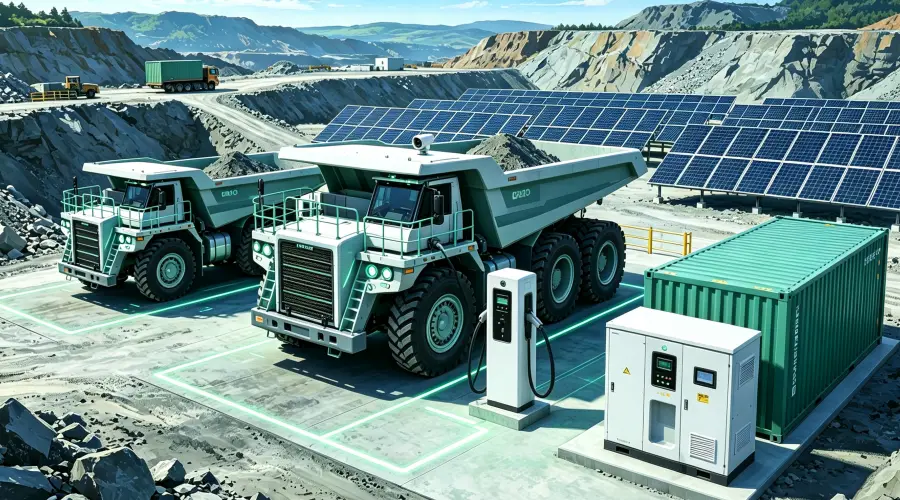
Mining & Industrial Operations
Off‑grid solar PV plus battery energy storage microgrid system for open‑pit mining sites. Deliver stable high‑power fast charging for electric mining haul trucks in remote industrial sites with limited utility grid access.
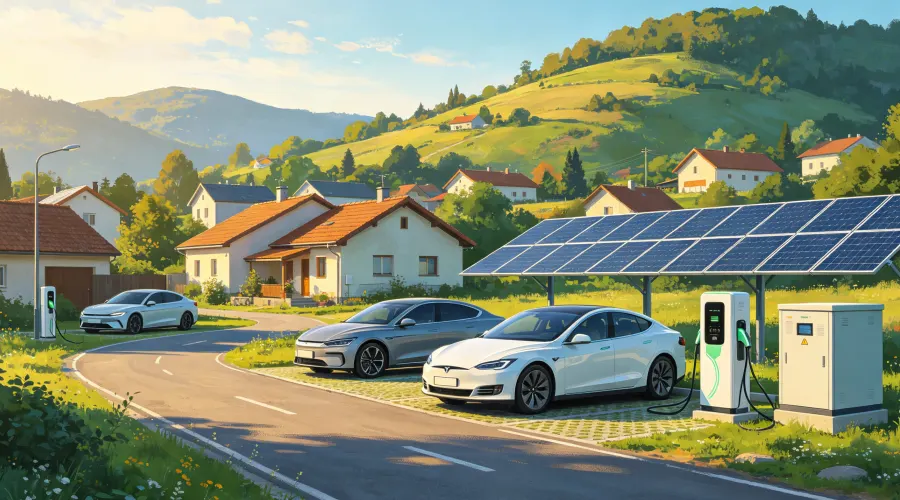
Rural & Remote Communities
Renewable off‑grid microgrid EV charging infrastructure for rural and remote villages. Solar‑battery storage setup brings accessible electric vehicle charging to locations with weak or unreliable public power grid.
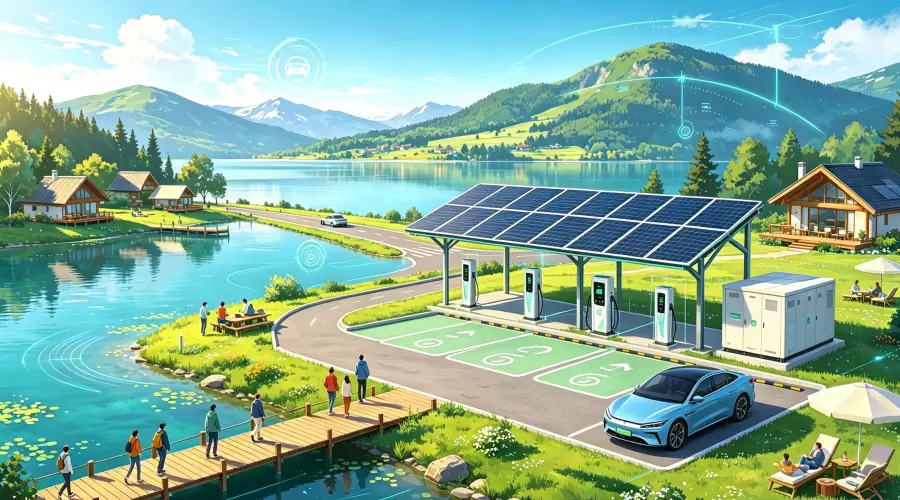
Tourism & Resort Destinations
Solar carport and battery energy storage charging hub for scenic spots, lakeside and coastal resorts. Provides clean off‑grid EV charging service for tourists while matching eco‑friendly resort environment requirements.
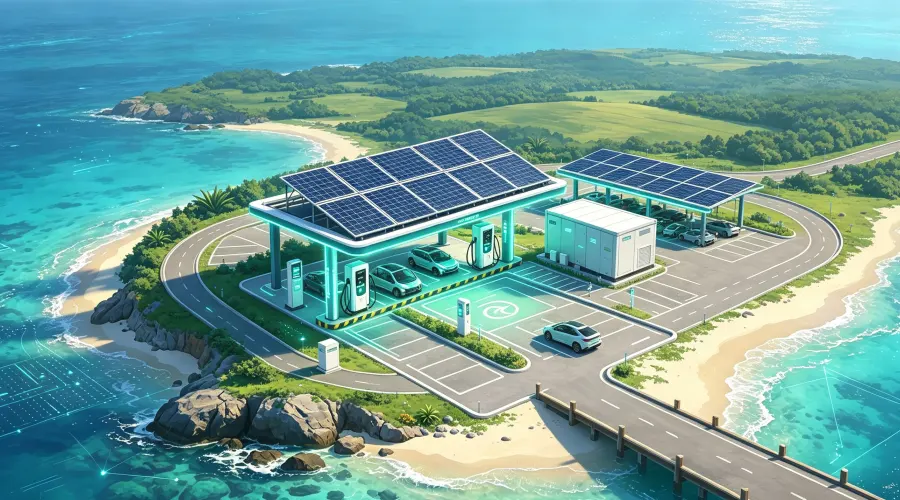
Islands & Off‑Grid Locations
Complete renewable microgrid EV charging solution for islands and fully off‑grid sites. Self‑sufficient solar plus battery storage eliminates reliance on main utility grid to support electric vehicle charging demands.
System Benefits
Reduce reliance on diesel generators
Lower operating costs
Lower carbon emissions
Improve energy independence
Provide 24/7 reliable EV charging
Typical System Configuration Range
FAQ-Off-Grid Solar EV Charging System Solutions
An off-grid solar EV charging system (also known as a standalone solar-powered charging station or off-grid microgrid EV charger) operates as an independent power generation and storage unit completely disconnected from the local electrical grid. The operational workflow involves three core integrated components:
Photovoltaic (PV) Solar Array: High-efficiency solar panels capture sunlight and generate Direct Current (DC) power.
Battery Energy Storage System (BESS): Excess daytime solar electricity is stored in high-density lithium-ion (LiFePO4) battery racks to provide continuous power buffer and nighttime energy supply.
Energy Management System (EMS) & Power Conversion: The central EMS continuously balances power generation, battery state of charge (SOC), and vehicle power demand. It directs DC power straight to vehicles via high-speed DC fast charging modules or through bidirectional inverters for AC charging.
By utilizing this hybrid solar-plus-storage architecture, the site guarantees uninterrupted 24/7 commercial EV charging, even in remote locations with zero grid access or limited transformer capacity.
Deploying off-grid solar charging infrastructure offers strategic financial, operational, and environmental advantages for fleet operators, commercial properties, and remote infrastructure projects:
Elimination of Grid Connection Costs & Delays: Avoid expensive grid interconnection upgrades, costly utility service line extensions, and multi-year utility permitting delays.
Diesel Generator Replacement: Dramatically cuts operational expenditures (OPEX) and fuel logistics by replacing loud, carbon-heavy diesel and gas generators with clean solar energy.
Reduced Operating Costs: Harness free, abundant solar power to charge electric cars, trucks, and buses, drastically lowering the total cost of ownership (TCO) per vehicle mile.
100% Zero-Emission Charging: Delivers true renewable energy charging without relying on fossil-fuel-dominated utility grids, enabling companies to meet strict ESG targets and carbon reduction compliance.
Grid Independence & Resilience: Provides emergency backup power and full immunity against regional power outages, grid blackouts, and fluctuating peak-demand utility tariffs.
Solar PV capacity for off-grid EV charging stations typically spans from 20 kWp for localized light-duty setups up to 1 MW+ for utility-scale fleets or highway hubs.
The exact photovoltaic array sizing depends on key variables, including daily EV mileage requirements, vehicle battery sizes, total target charge cycles per day, and peak solar peak-sun-hours (PSH) at the installation location. Ground-mounted solar arrays, solar carports with canopy structures, or containerized mobile solar solutions can be deployed to maximize energy harvesting relative to available land space.
Battery storage capacity generally ranges from 100 kWh to over 5 MWh+. Sizing your BESS correctly is critical to maintaining continuous off-grid fast charging operations when solar output drops or during heavy night-shift fleet charging.
Engineering calculations consider:
Overnight Charging Demand: The energy volume needed when solar generation is zero.
Autonomy Days: Buffer reserve capacity to maintain charging services during 2–3 consecutive cloudy or low-irradiance winter days.
C-Rate & Power Output: Ensuring the battery bank can sustain high-power discharge rates required by 120kW–480kW ultra-fast DC charging dispensers.
Modern off-grid charging stations support high-power DC Fast Chargers (DCFC) ranging from 60 kW to 480 kW+, alongside standard Level 2 AC chargers (7 kW to 22 kW).
These systems are compatible with global industry EV charging standard protocols and connectors, including CCS1, CCS2, NACS (Tesla standard), CHAdeMO, and GB/T. Advanced power-sharing controllers dynamically deliver high-voltage direct current (up to 1000V DC) to rapidly top up commercial electric trucks, delivery vans, passenger cars, e-buses, and heavy industrial mining fleets.
The Energy Management System (EMS) functions as the digital brain of the off-grid microgrid station. Equipped with IoT sensors, real-time data analytics, and automated control algorithms, the EMS optimizes power distribution by:
Dynamic Load Balancing: Automatically allocating available solar and battery power across multiple active charging ports to prevent system overloads.
Predictive Solar Analytics: Utilizing weather forecasts to manage energy reserves ahead of overcast weather conditions.
Battery Longevity Protection: Controlling depth of discharge (DoD), charge rates, and state-of-health (SoH) metrics to prevent thermal stress and extend battery life cycles.
Yes. The system is designed with a fully modular, plug-and-play architecture. Rather than overbuilding initial infrastructure, businesses can launch with a baseline configuration and scale up capacity seamlessly as their EV fleet expands.
You can modularly expand:
Solar PV arrays by appending additional string setups or modular carports.
BESS units by adding outdoor battery cabinets or containerized energy storage racks.
Charging dispensers by adding multi-connector power cabinets without replacing existing energy management hardware.
Engineered for demanding industrial and outdoor environments, the off-grid infrastructure features robust enclosure protection (IP65/NEMA 4X rated) and an operational ambient temperature range of -20°C to +50°C (-4°F to 122°F).
The system incorporates Liquid Cooling or advanced HVAC thermal management inside the BESS enclosures to protect sensitive lithium battery cells and power conversion electronics from overheating during desert conditions or freezing in cold winter climates.
While high-capacity battery storage compensates for cloudy days, multi-source hybrid microgrid setups can integrate an auxiliary power source for maximum mission-critical uptime:
Hybrid Diesel/Gas Generator Integration: An automated generator can act as a secondary backup, triggered automatically by the EMS only when the battery drops below a preset safety SOC threshold (e.g., 20%).
Wind Turbine Connectivity: In coastal or windy regions, small wind turbines can supplement solar generation, particularly during nighttime hours.
Off-grid solar EV fast-charging solutions are ideal for locations where grid power is unavailable, unreliable, or prohibitively expensive to connect. Key application scenarios include:
Remote Fleet Logistics Hubs: Electrified delivery fleets, logistics parks, and distribution centers facing utility transformer capacity bottlenecks.
Highway Rest Stops & National Parks: Remote corridor fast-charging stations for long-distance electric vehicle travel.
Mining, Construction & Agriculture Sites: Off-grid industrial locations transitioning heavy machinery, pickup trucks, and site transport to electric vehicles.
Temporary & Emergency Stations: Mobile containerized charging stations for temporary events, disaster relief, or fast deployment before permanent grid connections are finalized.
For EPCs, Commercial Developers & Fleet Operators
Let’s Architect Your Off-Grid Solar + BESS EV Charging Station
Planning an independent, zero-emission commercial fleet depot, highway fast-charging hub, or remote industrial charging site? Share your project specifications with us—including daily EV charging demand, available PV installation area, target DC fast charger counts (60kW–480kW+), solar PV capacity (kWp/MWp), and battery energy storage targets (kWh/MWh).
Our microgrid engineering team will conduct a comprehensive load profile analysis and deliver a customized system topology, Tier-1 equipment sizing, and a complete turnkey project quotation engineered for maximum operational uptime and accelerated ROI.
Latest News
Commercial Solar EV Charging Station with BESS: Design, Sizing & Cost Guide
As electric vehicle adoption continues to grow, businesses and fleet operators are facing a new [...]
Août
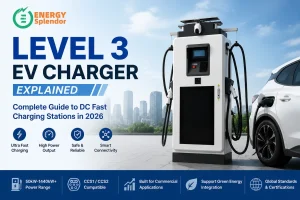
Tout savoir sur les bornes de recharge de niveau 3 pour véhicules électriques : guide complet des bornes de recharge rapide en courant continu en 2026
Alors que l'adoption des véhicules électriques continue de s'accélérer à l'échelle mondiale, les infrastructures de recharge sont devenues un élément essentiel [...]
Août
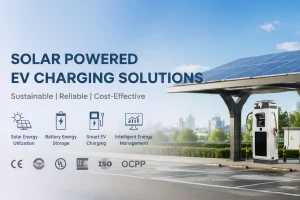
Chargeur solaire pour véhicules électriques : guide complet sur les bornes de recharge solaires pour véhicules électriques avec stockage par batterie
Chargeur pour véhicules électriques à énergie solaire : construire l'avenir des infrastructures de recharge renouvelables pour véhicules électriques. L'adoption rapide [...]
Juil
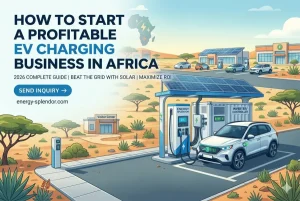
Comment lancer une activité rentable de recharge de véhicules électriques en Afrique (Guide complet 2026)
Comment lancer une activité rentable de recharge de véhicules électriques en Afrique (Guide complet 2026) Sous-titre : Découvrez [...]
Mai