



















Introduction: EV Charging Compatibility Is No Longer Optional
As electric vehicle adoption accelerates across North America and South America, EV charging infrastructure is expanding at an unprecedented pace. Governments are investing heavily, private operators are racing to deploy charging networks, and commercial buyers are under pressure to make the right equipment decisions.
However, one issue continues to delay projects and increase costs:
Electric vehicle charging compatibility.
Charging compatibility affects which vehicles can charge, how reliably they charge, whether the station can be legally installed, and how profitable the investment becomes over time. For buyers, operators, and distributors, misunderstanding compatibility can lead to failed deployments, stranded assets, or expensive retrofits.
This guide provides a clear, buyer-focused explanation of EV charging compatibility and outlines practical, proven solutions for commercial projects in North America and South America.
1. What Does EV Charging Compatibility Really Mean?
EV charging compatibility is not a single factor. It is the result of multiple technical, electrical, software, and regulatory elements working together.
From a buyer’s perspective, compatibility determines:
Whether different EV brands can charge
Whether charging is stable and fast
Whether the charger complies with local regulations
Whether the station remains usable as standards evolve
Let’s break it down.
2. Connector Standards: Vehicle-to-Charger Compatibility
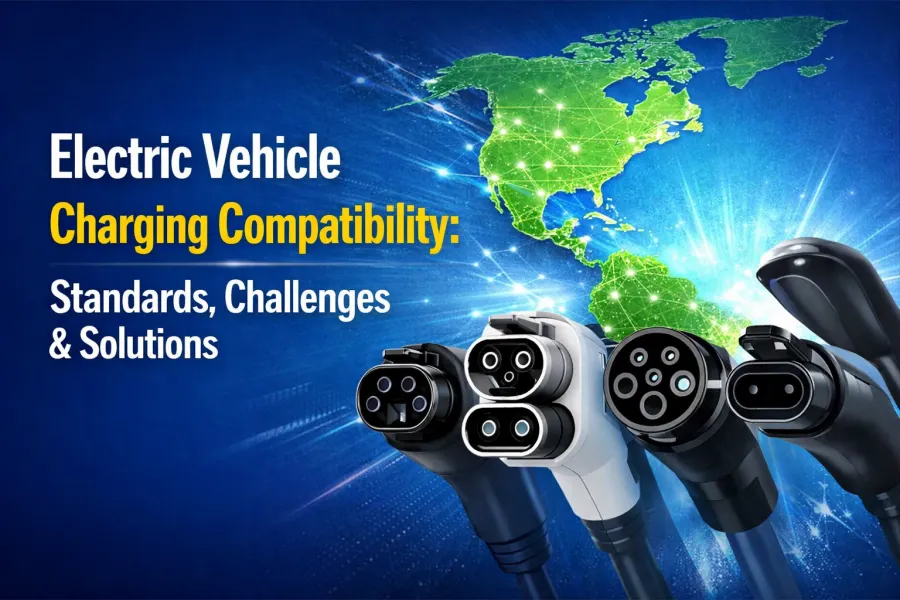
2.1 Major EV Connector Types Worldwide
Different regions and automakers use different charging connectors, especially for DC fast charging.
| Connector | Primary Markets | Typical Vehicles |
|---|---|---|
| CCS1 | United States, Canada | Ford, GM, Rivian, Hyundai, Kia |
| CCS2 | Europe, parts of South America | VW, BMW, Mercedes |
| CHAdeMO | Japan, legacy fleets | Nissan Leaf |
| GB/T | China | BYD, SAIC (export varies) |
| NACS (Tesla) | North America | Tesla, Ford (future), GM (future) |
Buyer Reality:
A charger that supports only one connector limits vehicle access, reduces utilization rates, and shortens the station’s commercial lifespan.
Best Practice:
Commercial EV chargers should be:
Multi-standard
Or designed with replaceable / upgradeable connectors
3. AC vs DC Charging: Power Compatibility Matters
3.1 AC Charging (Nivel 2)
Rango de potencia: 7kW – 22kW
Ideal para:
Hoteles
Oficinas
Residential and long-stay parking
Slower charging, lower grid requirements
3.2 DC Fast Charging (Level 3)
Rango de potencia: 30kW – 360kW+
Essential for:
Autopistas
Depósitos de flotas
Public fast-charging hubs
Requires precise power, cooling, and communication compatibility
Market Insight:
In North America and South America, DC fast charging is becoming the primary growth segment, especially for:
Logistics fleets
Ride-hailing
Intercity travel corridors
4. Communication Protocols: The Invisible Compatibility Layer
Even when connectors and power match, chargers and vehicles must communicate correctly.
Key Protocols:
OCPP 1.6 / OCPP 2.0.1
Charger ↔ backend platform communicationISO 15118
Vehicle ↔ charger communication (Plug & Charge, smart charging)DIN 70121
Legacy DC charging communication
Common Buyer Problem:
Chargers that:
Work during testing
Fail after software updates
Cannot integrate with third-party charging platforms
Buyer Solution:
Choose chargers with:
Open protocols
Long-term software upgrade support
Proven interoperability testing
Read More:A Complete Guide to Electric Vehicle Charging Compatibility, Standards, and Solutions
5. Electrical Grid Compatibility: Often Overlooked, Always Critical
Grid conditions vary significantly between regions and even cities.
Typical Requirements:
North America:
208V / 480V, 60HzSouth America:
380V / 400V / 480V, 50–60Hz (country-dependent)
Risk:
Incorrect voltage or frequency configuration can cause:
Reduced charging power
System instability
Component failure
Best Practice:
Buyers should work with manufacturers that offer market-specific electrical customization.
6. Certification & Regulatory Compatibility
6.1 North America
UL certification
CSA compliance
NEC requirements
6.2 South America
INMETRO (Brazil)
NOM (Mexico)
Local grid and safety standards
Critical Buyer Insight:
A charger that is technically compatible but not certified:
May be blocked at customs
Cannot be installed legally
Will be rejected by utilities or inspectors
7. Common Compatibility Problems Faced by Buyers
❌ Single-standard chargers that exclude certain vehicles
❌ Imported chargers without local certifications
❌ Software locked to one backend system
❌ Non-upgradable power architecture
❌ Lack of after-sales technical support
These issues increase:
Project delays
Operating costs
Customer complaints
Long-term investment risk
8. Proven Compatibility Solutions for Commercial Projects
8.1 Multi-Standard DC Fast Charging Stations
Modern DC chargers should support:
CCS1 / CCS2
CHAdeMO (optional)
NACS readiness for North America
This ensures compatibility with:
Tesla, BYD, Ford, GM, Nissan, Hyundai, Kia, and more.
8.2 Modular Power Design
Entre las ventajas se incluyen:
Scalable power (20kW / 30kW / 40kW / 60kW modules)
Easier maintenance and lower downtime
8.3 Open Software Architecture
Commercial buyers benefit from:
OCPP compliance
Multiple payment integrations
Third-party backend compatibility
Remote monitoring and diagnostics
8.4 Market-Specific Customization
A professional EV charger supplier should offer:
Voltage and frequency customization
Connector configuration by market
Certification guidance
Language and UI localization
OEM / ODM branding options
9. EV Charging Compatibility Trends in North & South America
North America
Rapid adoption of Tesla NACS
Strong focus on UL-certified DC fast chargers
High-power charging becoming standard
South America
Mixed connector environments
Rapid public infrastructure growth
Strong demand for cost-effective, factory-direct solutions
Key Trend:
Buyers increasingly prefer direct cooperation with experienced Chinese EV charger manufacturers to balance quality, flexibility, and cost.
10. How Buyers Should Evaluate EV Charging Compatibility
Before purchasing, buyers should ask:
✔ Which vehicle brands will use this charger?
✔ Is the charger future-ready for new standards?
✔ Are certifications available or supported?
✔ Can power be expanded later?
✔ Is long-term software support guaranteed?
11. Why Energy Splendor Is a Trusted Compatibility Partner
Energy Splendor is a professional EV charging station manufacturer from China, serving North America and South America with:
AC and DC EV charging stations
Power ranges from 7kW to 360kW+
Multi-standard connector support
Open protocol software architecture
OEM / ODM customization
Factory-direct pricing
Certification and compliance support
Our charging solutions are designed to reduce compatibility risks, shorten deployment timelines, and maximize long-term returns.
Conclusion: Compatibility Determines Success
EV charging compatibility is not a technical detail—it is a strategic purchasing decision.
The right charging solution ensures:
Maximum vehicle coverage
Stable operation
Regulatory approval
Long-term scalability
Strong ROI
🚀 Ready to Invest in Compatible EV Charging Solutions?
If you are:
Planning a commercial EV charging project
Expanding a charging network
Looking for a reliable factory-direct supplier
👉 Ponte en contacto con Energy Splendor hoy mismo for:
Technical consultation
Compatible charging solutions
Competitive pricing and customization
Energy Splendor — powering compatible, scalable, and future-ready EV charging infrastructure worldwide.