



















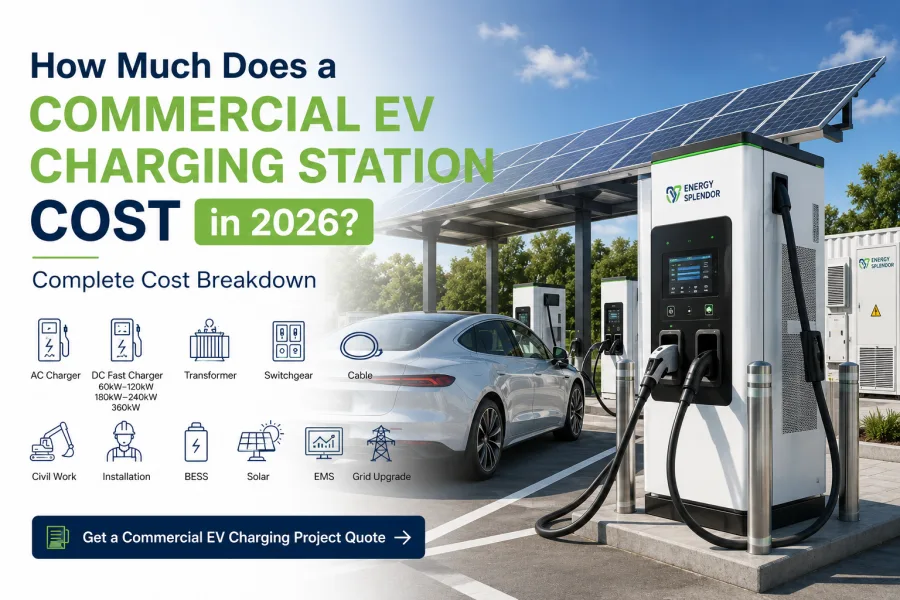
Planning a commercial EV charging station in 2026? The total cost can range from a relatively small investment for several AC chargers to a major infrastructure project involving high-power DC fast chargers, transformers, switchgear, battery energy storage, solar PV, EMS, and utility upgrades.
The charger itself is only one part of the total project cost.
For commercial and fleet charging projects, the final investment depends on several factors, including charger power, number of charging ports, grid capacity, electrical infrastructure, installation conditions, civil work, and whether the project integrates BESS or solar power.
This guide explains the major cost components of a commercial EV charging station and provides a practical framework for estimating your project budget in 2026.
Quick Answer: How Much Does a Commercial EV Charging Station Cost?
There is no single fixed price for a commercial EV charging station because project configurations vary significantly.
A basic commercial charging site with several AC chargers may require a relatively modest investment, while a fleet depot or public fast-charging hub with multiple 120kW–360kW DC fast chargers can require substantial electrical infrastructure.
A typical project budget may include:
| Cost Component | Typical Project Requirement |
|---|---|
| EV Chargers | AC or 60kW–360kW+ DC fast chargers |
| Transformer | Required when existing grid capacity is insufficient |
| Switchgear | Main distribution and electrical protection |
| Cables | Power cables, communication cables and accessories |
| Civil Work | Foundations, trenching, parking modifications and equipment bases |
| Instalación | Electrical installation, commissioning and testing |
| BESS | Optional battery storage for peak shaving and grid optimization |
| Energía solar fotovoltaica | Optional renewable energy generation |
| EMS | Energy monitoring, control and load management |
| Grid Upgrade | Required when existing utility capacity cannot support the charging load |
Important: The EV charger purchase price should not be treated as the total project cost.
For large commercial charging projects, electrical infrastructure and grid-related costs can become a significant part of the overall investment.
What Determines Commercial EV Charging Station Cost?
The total cost of a commercial EV charging station is primarily determined by nine factors:
- Charger type
- Charger power
- Number of chargers
- Required electrical capacity
- Transformer and switchgear requirements
- Cable distance and installation conditions
- Civil work
- Grid connection or utility upgrade requirements
- Solar PV, BESS and EMS integration
The first step is therefore to determine the charging demand of the site.
1. AC Charger Cost
AC chargers are commonly used for applications where vehicles remain parked for several hours.
Entre las aplicaciones típicas se incluyen:
- Recarga en el lugar de trabajo
- Commercial parking
- Hoteles
- Apartment buildings
- Centros comerciales
- Office campuses
- Employee parking
- Long-duration fleet parking
Compared with high-power DC fast chargers, AC charging stations generally require lower charging power and simpler electrical infrastructure.
However, a commercial AC charging project may still require:
- Distribution panels
- Circuit protection
- Power cables
- Load management
- Communication infrastructure
- Instalación
- Parking-space modifications
For a small site, the charger hardware may represent a significant portion of the project budget. For a larger site, however, electrical infrastructure and installation can become increasingly important.
2. DC Fast Charger Cost
DC fast chargers are designed for applications where vehicles need to recharge quickly.
They are commonly used for:
- Depósitos de flotas
- Estaciones de recarga en autopistas
- Centros logísticos
- Commercial charging hubs
- Electric bus charging
- Electric truck charging
- Public fast-charging networks
- High-utilization commercial sites
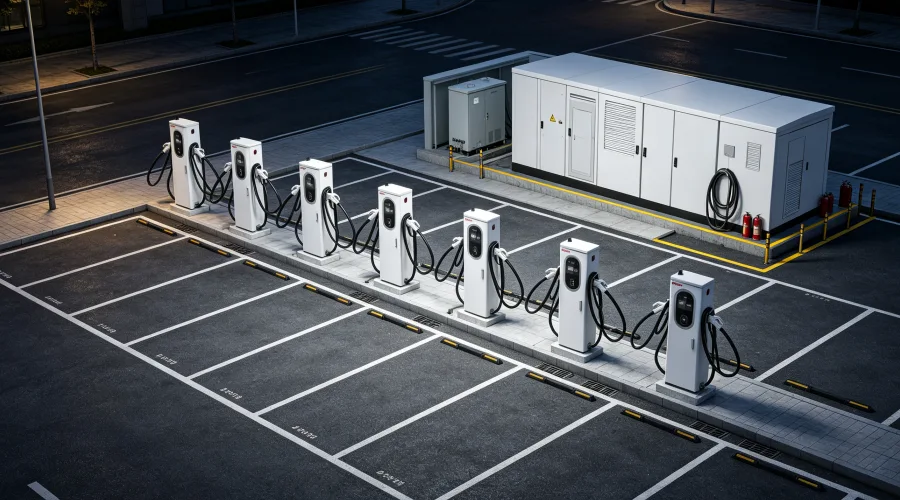
DC charger cost increases with output power, system architecture, number of connectors and required electrical infrastructure.
For commercial applications, common power levels include:
| DC Charger Power | Typical Application |
|---|---|
| 60 kW | Small commercial sites and fleet charging |
| 120 kW | Commercial and fleet charging |
| 180 kW | High-utilization fleet and public charging |
| 240 kW | High-power commercial charging |
| 360kW | High-power fleet, highway and charging hub applications |
Higher-power charging can reduce vehicle charging time, but it also increases the electrical demand of the site.
For example, installing several 240kW or 360kW chargers can create a very large instantaneous load.
That is why charger selection should always be evaluated together with the site’s electrical infrastructure.
3. 60kW vs 120kW vs 180kW vs 240kW vs 360kW
Choosing the highest-power charger is not always the most economical solution.
The correct power level depends on:
- Vehicle battery capacity
- Daily mileage
- Número de vehículos
- Vehicle arrival schedule
- Required turnaround time
- Parking duration
- Grid capacity
- Available transformer capacity
- Project budget
60kW DC Fast Charger
A 60kW charger can be suitable for smaller commercial sites where vehicles have longer dwell times.
Potential applications include:
- Small fleets
- Workplace fleets
- Dealerships
- Commercial parking
Cargador rápido de 120 kW de corriente continua
120kW is a practical option for many commercial and fleet charging projects.
It provides substantially faster charging while avoiding some of the infrastructure requirements associated with very high-power systems.
Cargador rápido de 180 kW de corriente continua
180kW charging is suitable when fleet vehicles need faster turnaround.
Potential applications include:
- Logistics fleets
- Delivery vans
- Commercial vehicle depots
- Public fast charging
240kW DC Fast Charger
240kW systems are designed for higher-utilization charging environments.
They may be suitable for:
- Depósitos de flotas
- Highway charging
- Commercial charging hubs
- Large logistics facilities
360kW DC Fast Charger
360kW charging is aimed at high-power applications where minimizing charging time is a priority.
These systems can be attractive for:
- Centros de recarga en autopistas
- Heavy-duty fleet operations
- High-utilization commercial sites
- Future-ready charging infrastructure
However, high-power charging can create significant peak electrical demand.
This is where BESS, EMS and intelligent load management can become valuable.
4. Transformer Cost
The transformer is one of the most important infrastructure components in a commercial EV charging project.
Consider a simplified example.
If a site has:
4 × 240kW DC chargers
the theoretical maximum charging load is:
960 kW
If additional site loads are included, the required electrical capacity can be even higher.
The existing utility connection may not have enough capacity to support this demand.
A new or upgraded transformer may therefore be required.
Transformer requirements depend on:
- Total charger power
- Simultaneous charging demand
- Existing site load
- Utility voltage
- Required redundancy
- Local electrical standards
- Future expansion plans
The transformer should therefore be sized based on the overall electrical system rather than simply adding the nameplate ratings of the chargers.
5. Switchgear Cost
Commercial EV charging infrastructure requires appropriate electrical protection and distribution equipment.
Depending on the project, this may include:
- Main switchgear
- Distribution boards
- Circuit breakers
- Protection devices
- Metering
- Disconnect switches
- Surge protection
- Busbars
- Monitoring equipment
Switchgear requirements become increasingly important as charging power increases.
A small AC charging installation may use relatively simple distribution equipment.
A large DC fast-charging hub can require dedicated medium-voltage or low-voltage distribution infrastructure depending on the local grid connection.
6. Cable Cost
Cable cost is another factor that can vary significantly between projects.
The total cable requirement depends on:
- Charger power
- Cable length
- Cable cross-section
- Voltage
- Installation method
- Trenching requirements
- Distance between transformer and chargers
- Local electrical regulations
High-power DC chargers require substantial electrical conductors.
A site where chargers are located close to the electrical room may have significantly lower installation costs than a site requiring long underground cable runs.
Therefore, when estimating EV charging station installation cost, cable distance should always be considered.
7. Civil Work Cost
Civil work is often underestimated when calculating EV charging station costs.
Depending on the site, civil work may include:
- Charger foundations
- Equipment pads
- Concrete work
- Cable trenches
- Underground conduits
- Parking-space modifications
- Bollards and protective structures
- Drainage
- Road surface restoration
- Signage and site preparation
For a new-build charging station, civil work can be incorporated into the original site design.
For an existing commercial property, however, construction and trenching can become a significant cost component.
8. EV Charger Installation Cost
The charger purchase price is only part of the investment.
EV charger installation cost can include:
- Electrical engineering
- Equipment transportation
- Charger positioning
- Electrical connections
- Cable installation
- Protection equipment
- Communication setup
- Software configuration
- Testing
- Commissioning
- Inspection
- Site restoration
Installation cost is strongly affected by site conditions.
For example, installing a charger next to an existing electrical room is generally simpler than installing chargers hundreds of meters away from the main distribution equipment.
9. Grid Upgrade Cost
Grid capacity is one of the most important factors in commercial EV charging projects.
Suppose a fleet operator wants to install:
6 × 180kW DC chargers
The theoretical maximum charger load is:
1.08MW
But the site may already have:
- HVAC
- Lighting
- Production equipment
- Refrigeration
- Office loads
- Warehouse equipment
- Other electrical systems
The existing utility connection may therefore be insufficient.
A grid upgrade may involve:
- Increasing utility service capacity
- Installing a larger transformer
- Upgrading switchgear
- New utility connection equipment
- New electrical distribution
- Engineering studies
- Utility approval
- Additional infrastructure
The cost and timeline of a grid upgrade vary considerably by location and utility provider.
This is why grid capacity should be evaluated before finalizing the charger configuration.
Can BESS Reduce Commercial EV Charging Infrastructure Costs?
Yes. Battery Energy Storage Systems (BESS) can be used to manage charging demand and reduce dependence on instantaneous grid power.
A simplified system can operate as:
Grid + BESS → EV Chargers
During periods of high charging demand, the BESS can provide additional power to the chargers.
This can reduce the peak power drawn from the grid.
For example, a site may require high-power charging during several hours of the day but have limited grid capacity.
Instead of immediately upgrading the utility connection, the project can evaluate a configuration combining:
Grid + BESS + DC Fast Chargers + EMS
The appropriate BESS size depends on:
- Charger power
- Número de vehículos
- Calendario de cobros
- Grid capacity
- Peak demand
- Required charging duration
- Battery power rating
- Battery energy capacity
- Electricity tariff structure
BESS is therefore not simply an additional battery product. It can become part of the site’s overall power infrastructure strategy.
Solar PV + BESS + EV Charging
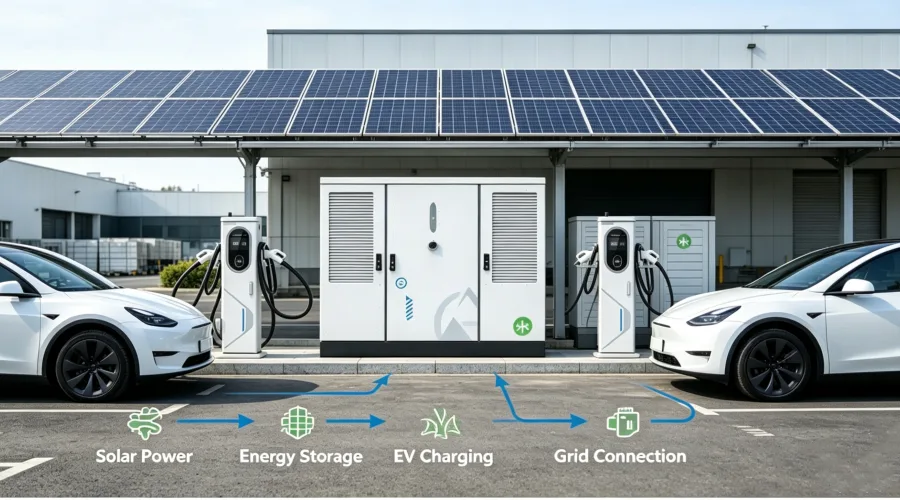
For commercial and fleet projects, solar PV can be integrated with BESS and EV charging to create a more comprehensive energy system.
A typical architecture can include:
Solar PV → PV Inverter → AC Bus
Grid → Transformer → Main Switchgear → AC Bus
BESS ↔ PCS ↔ AC Bus
AC Bus → EV Chargers → EVs
EMS → Monitoring + Control
The EMS coordinates energy flows and charging loads based on the project configuration.
Solar generation can provide renewable electricity for EV charging, while BESS can store excess solar energy and support charging demand when solar production is unavailable.
A combined system can therefore include:
- Energía solar fotovoltaica
- Battery Energy Storage
- PCS
- Cargadores rápidos de corriente continua
- AC Chargers
- EMS
- Transformer
- Switchgear
- Grid connection
This approach is particularly relevant for commercial campuses, fleet depots, logistics facilities and large EV charging hubs.
Read More:Commercial Solar EV Charging Station with BESS: Design, Sizing & Cost Guide
How EMS Affects Commercial EV Charging Costs
An Energy Management System (EMS) does not replace electrical equipment such as transformers or switchgear.
Instead, EMS provides monitoring, control and optimization functions.
Depending on the system architecture, EMS can monitor:
- Grid power
- Transformer loading
- EV charger status
- Charging power
- BESS state of charge
- Generación solar
- Site energy consumption
It can then coordinate charging and energy storage according to predefined operating strategies.
For example:
Solar Generation High
→ Charge vehicles / charge BESS
Grid Demand High
→ Reduce charging power / discharge BESS
Grid Capacity Limited
→ Dynamically distribute available power between chargers
This type of intelligent load management can be particularly valuable for high-power commercial charging projects.
Example: Commercial EV Charging Station Cost Structure
Consider a hypothetical fleet depot requiring:
6 × 180kW DC fast chargers
Maximum charger capacity:
6 × 180kW = 1,080kW
The project may require an infrastructure assessment covering:
Charging Equipment
- 6 × 180kW DC fast chargers
- Charging cables and connectors
- Communication systems
Electrical Infrastructure
- Transformer
- Main switchgear
- Distribution equipment
- Protection devices
- Metering
- Power cables
Construction
- Charger foundations
- Cable trenching
- Conduits
- Parking modifications
- Protective bollards
Energy System
Potentially:
- BESS
- PCS
- Energía solar fotovoltaica
- PV inverter
- EMS
Cuadrícula
Potentially:
- Utility service upgrade
- Transformer upgrade
- New connection infrastructure
The total project cost is therefore much more than:
6 × charger unit price
A professional project quotation should evaluate the complete system.
Get More:Level 3 EV Charger Explained: Complete Guide to DC Fast Charging Stations in 2026
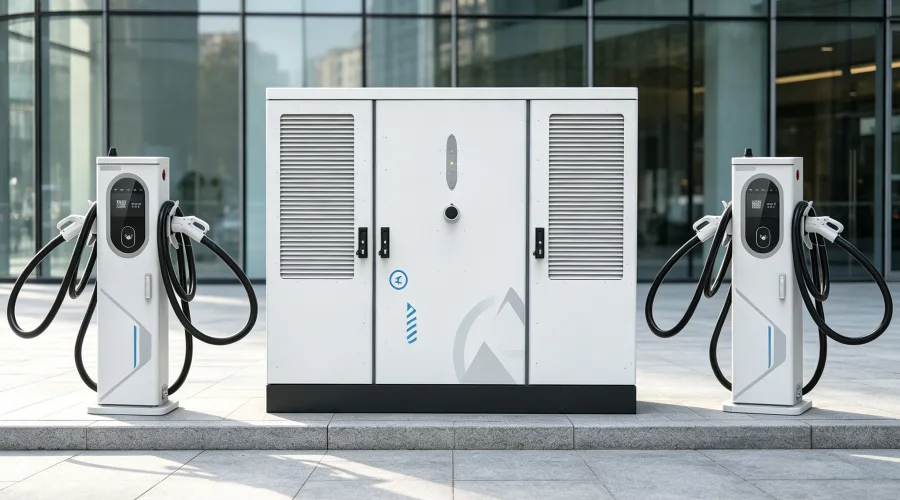
Commercial EV Charging Station Cost: What Should You Budget For?
When requesting a quotation, provide the supplier with as much project information as possible.
At minimum, include:
1. Project Type
- Fleet depot
- Commercial parking
- Highway charging
- Logistics center
- Workplace
- Bus depot
- Truck charging
2. Number of Vehicles
For example:
- 20 vehicles
- 50 vehicles
- 100 vehicles
- 500 vehicles
3. Charger Requirements
For example:
- 60 kW
- 120 kW
- 180 kW
- 240 kW
- 360kW
4. Existing Grid Capacity
For example:
- 250kVA
- 500kVA
- 1MVA
- 2MVA
5. Solar Requirement
Specify whether you want:
- No solar
- Energía solar fotovoltaica
- Solar carport
- Large-scale PV
6. BESS Requirement
Specify whether you need:
- No BESS
- Reducción de picos de demanda
- Grid capacity support
- Renewable energy storage
- Backup power
- Energy arbitrage
7. Project Location
The location is important because electrical standards, utility requirements, installation conditions and grid connection procedures vary by market.
Commercial EV Charging Station Cost: Hardware vs Total Project Cost
One of the most important distinctions is:
EV Charger Price ≠ EV Charging Station Cost
The complete project may be divided into:
| Categoría | Examples |
|---|---|
| Charging Equipment | AC / DC chargers |
| Electrical Infrastructure | Transformer / switchgear / distribution |
| Cabling | AC / DC power cables |
| Civil Work | Foundations / trenching / parking |
| Instalación | Electrical installation / commissioning |
| Energy Storage | BESS / PCS |
| Renewable Energy | Solar PV / inverter |
| Gestión energética | EMS |
| Utility | Grid connection / capacity upgrade |
| Engineering | System design / testing / certification |
This is why two projects with the same number of EV chargers can have completely different total costs.
How to Reduce Commercial EV Charging Station Costs
A lower initial equipment price does not necessarily mean a lower total project cost.
A better approach is to optimize the complete system.
1. Select the Right Charger Power
Do not automatically choose the highest available power.
Match charger power to actual vehicle requirements and dwell time.
2. Optimize Charger Quantity
Determine how many vehicles need to charge simultaneously.
3. Evaluate Dynamic Load Management
Dynamic power allocation can help distribute available electrical capacity among chargers.
4. Evaluate BESS
For sites with limited grid capacity or high demand charges, BESS may provide an alternative or supplement to grid upgrades.
5. Integrate Solar PV
Solar can provide renewable generation and reduce reliance on grid electricity during periods of solar production.
6. Use EMS
EMS can coordinate charging, solar generation, BESS operation and grid power.
7. Plan for Future Expansion
A properly designed electrical infrastructure can make future charger expansion easier and reduce the need for major reconstruction.
Commercial EV Charging Station Cost by Project Type
Different applications have different infrastructure requirements.
Workplace Charging
Typically emphasizes:
- AC charging
- Moderate charging power
- Long parking duration
- Load management
Fleet Depot
Typically emphasizes:
- Carga rápida de corriente continua
- High simultaneous load
- Charging schedules
- BESS
- EMS
- Fleet management
Highway Charging Hub
Typically emphasizes:
- High-power DC charging
- 180kW–360kW+ chargers
- High utilization
- Large electrical infrastructure
- Grid capacity
- Potential BESS integration
Logistics Center
Typically emphasizes:
- Fleet charging
- Electric vans and trucks
- Scheduled charging
- High charger utilization
- Energía solar fotovoltaica
- BESS
- EMS
How to Get an Accurate Commercial EV Charging Station Quote
Online charger prices can provide a general reference, but they cannot determine the final cost of a complete commercial charging project.
For an accurate quotation, the supplier should evaluate:
Vehicle Demand
↓
Charger Power
↓
Charging Quantity
↓
Grid Capacity
↓
Transformer & Switchgear
↓
Cable & Civil Work
↓
BESS / Solar / EMS
↓
Installation & Commissioning
↓
Complete Project Cost
This approach provides a much more realistic project budget than simply multiplying the charger quantity by a unit price.
Get a Commercial EV Charging Project Quote
Planning a commercial EV charging station, fleet depot, DC fast charging hub or solar + BESS charging system?
Energy Splendor provides integrated EV charging solutions covering EV chargers, electrical infrastructure, BESS, solar PV and EMS for commercial and fleet applications.
We can help evaluate your project requirements and recommend an appropriate system configuration based on:
- Required charger quantity
- 60kW / 120kW / 180kW / 240kW / 360kW charging power
- Fleet size
- Daily charging demand
- Existing grid capacity
- Transformer requirements
- BESS capacity
- Solar PV capacity
- EMS and load management
- Project location
- Future expansion requirements
Request a Customized Commercial EV Charging Solution
Send us your project information, and our engineering team can help you evaluate the appropriate EV charger, electrical infrastructure, BESS, solar and EMS configuration for your application.
Get a Commercial EV Charging Project Quote →
Frequently Asked Questions
How much does a commercial EV charging station cost?
The total cost depends on charger type, power, quantity, electrical infrastructure, installation, civil work, grid capacity and optional Solar PV, BESS and EMS systems. A complete commercial project should therefore be evaluated as a system rather than based only on charger price.
How much does a DC fast charging station cost?
DC fast charging station cost varies according to charger power, number of charging ports and infrastructure requirements. 60kW, 120kW, 180kW, 240kW and 360kW systems can have substantially different electrical requirements.
Is a transformer required for EV charging?
Not always. It depends on the existing electrical capacity of the site and the total charging load. High-power commercial charging projects may require a dedicated or upgraded transformer.
How much does EV charger installation cost?
Installation cost depends on cable distance, trenching, charger location, electrical infrastructure, civil work, labor, local regulations and commissioning requirements.
Can BESS reduce EV charging infrastructure costs?
BESS can help manage peak charging demand and support sites where grid capacity is limited. Whether BESS is more economical than a grid upgrade depends on the project, utility requirements, electricity tariffs and operating profile.
Can solar power be combined with EV charging?
Yes. Solar PV can be integrated with EV chargers, BESS and EMS to create an integrated renewable EV charging system.
What is the best DC fast charger power for a commercial fleet?
There is no universal answer. 60kW may be appropriate for smaller fleets, while 120kW, 180kW, 240kW or 360kW may be more suitable for fleets requiring faster vehicle turnaround. The correct choice depends on vehicle type, daily mileage, dwell time, fleet size and grid capacity.
Final Takeaway
The cost of a commercial EV charging station in 2026 should be evaluated as a complete infrastructure project.
The charger is only one component.
A complete commercial charging system may include:
EV Chargers + Transformer + Switchgear + Cables + Civil Work + Installation + Grid Connection + BESS + Solar PV + EMS
For small commercial installations, charger hardware may dominate the investment.
For large fleet depots and high-power charging hubs, however, electrical infrastructure, grid capacity, installation and energy management can have an equally important impact on the total project cost.
The best strategy is therefore not simply to find the cheapest EV charger.
It is to design the right charging infrastructure for the site’s power capacity, vehicle demand and future expansion requirements.
Need help estimating your commercial EV charging project? Contact Energy Splendor for a customized system assessment and quotation.