



















As electric vehicles (EVs) continue to reshape the transportation landscape worldwide, commercial DC fast charging infrastructure has become a cornerstone for sustainable mobility. At the heart of every reliable DC fast charging station lies the EV charging module—a key component that determines charging speed, energy efficiency, reliability, and overall return on investment.
This guide is designed for EV charging station operators, EPC contractors, and OEM manufacturers seeking to choose the right DC fast charging modules for global commercial deployments. From understanding module specifications to comparing power ratings and future-proofing strategies, this article covers everything you need to know.
Table of Contents
What Is a DC Fast Charging Module?
Why the Right Charging Module Matters for Commercial Projects
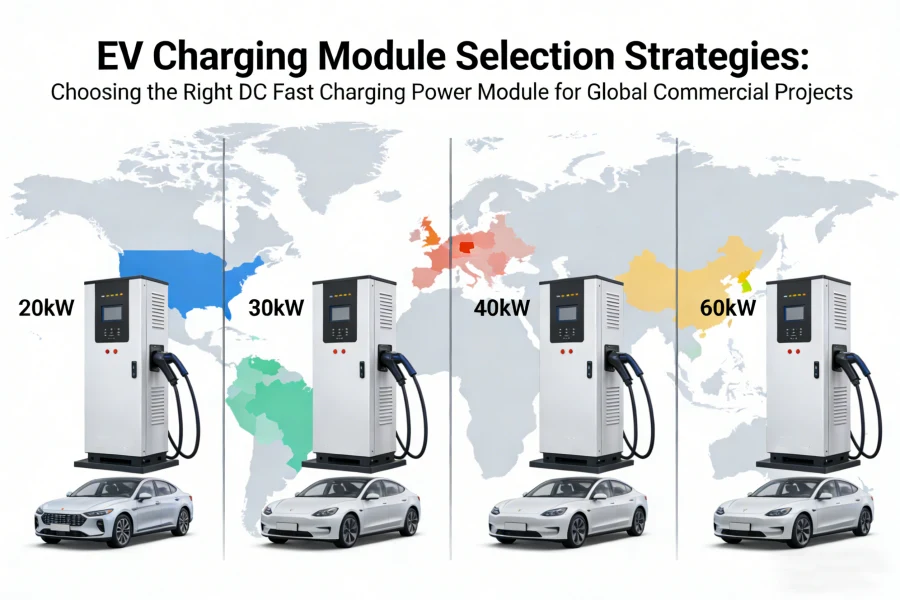
Power Ratings Overview: 20kW, 30kW, 40kW, 60kW
Global Deployment Considerations for DC EV Modules
Technical Factors to Evaluate
Output Voltage and Current Flexibility
Conversion Efficiency and Energy Savings
Thermal Management: Air-Cooled vs Liquid-Cooled
Communication Protocols and Smart Control
Certifications and International Compliance
Modularity, Maintainability, and Upgrade Paths
Comparing Popular DC Charging Module Configurations
Pricing Strategies for Large-Scale Commercial Deployments
Applications Across Different Sectors
Future Trends in DC Fast Charging Modules
How Energy Splendor Supports Global Commercial DC Charging Projects
Final Recommendations
What Is a DC Fast Charging Module?
A DC fast charging module, also called a DC power conversion module, is the core component of a DC fast charging station. Its main function is to convert AC grid power into controlled DC voltage and current suitable for EV batteries.
Modern commercial DC chargers adopt modular architecture, allowing operators to combine multiple modules to achieve higher power output (e.g., 60kW and above) and simplify maintenance. This modularity ensures scalability, operational flexibility, and long-term reliability.
Why the Right Charging Module Matters for Commercial Projects
In commercial deployments—public charging hubs, fleet depots, and highway stations—the choice of DC charging module directly impacts:
Charging Speed: Supports fast, efficient battery replenishment.
System Uptime: Minimizes downtime and maintenance disruptions.
Operating Costs: High-efficiency modules lower energy losses and heat generation.
Return on Investment (ROI): Reliable modules prevent costly replacements and service interruptions.
Selecting an inappropriate module can result in derated performance, frequent failures, or expensive upgrades, undermining both profitability and user experience.
Power Ratings Overview: 20kW, 30kW, 40kW, 60kW
DC charging modules are available in multiple power levels:
20kW Modules: Ideal for low-traffic commercial sites, pilot stations, or small fleet applications. Lower upfront cost and compact footprint.
30kW Modules: Balanced solution for modular DC chargers, offering efficiency and scalability for medium-demand locations.
40kW Modules: Suitable for higher-speed charging stations; often deployed in multi-module systems for busy commercial hubs.
60kW Modules: Designed for high-power charging hubs, highway stations, and future-proof deployments. Fewer modules are needed per station, reducing complexity.
Global Deployment Considerations for DC EV Modules
Commercial projects serving international markets must account for:
Voltage and Frequency Variations: Modules should support global AC input standards.
Safety Standards Compliance: CE, UL, IEC, and regional certifications ensure regulatory compliance.
Climate Adaptability: Cooling solutions must handle high-temperature regions or extreme cold.
Grid Compatibility: Integration with local energy management systems and renewable sources (solar, wind) may be required.
Technical Factors to Evaluate
Output Voltage and Current Flexibility
Wide output ranges enable compatibility with multiple EV models and battery types.
Conversion Efficiency and Energy Savings
High-efficiency modules (≥96%) reduce energy loss, lower operational costs, and improve cooling performance.
Thermal Management: Air-Cooled vs Liquid-Cooled
Effective heat dissipation ensures module longevity. Liquid-cooled modules excel in high-density, high-power applications, while air-cooled solutions fit medium-power deployments.
Communication Protocols and Smart Control
Modules should support CAN, PLC, or OCPP protocols for smart charging, load balancing, and remote diagnostics.
Certifications and International Compliance
Global projects require CE, UL, IEC certifications and sometimes regional approvals to meet local safety regulations.
Modularity, Maintainability, and Upgrade Paths
Hot-swappable modular designs allow easy replacement and system upgrades, minimizing downtime for commercial stations.
Comparing Popular DC Charging Module Configurations
| Power Rating | Typical Use Case | Number of Modules | Notes |
|---|---|---|---|
| 20kW | Low-traffic stations, pilot projects | 1–2 | Compact, lower cost |
| 30kW | Medium-demand commercial chargers | 2–4 | Balance of scalability & efficiency |
| 40kW | Multi-module fast charging stations | 2–6 | Faster charging for high throughput |
| 60kW | Highway & fleet charging hubs | 1–4 | High-power, future-proof |
Pricing Strategies for Large-Scale Commercial Deployments
Factors influencing DC module pricing include:
Power rating and quantity
Certification and compliance requirements
OEM/ODM customization and factory-direct sourcing
Shipping and installation for international projects
Sourcing modules from experienced manufacturers like Energy Splendor ensures competitive pricing and consistent global quality.
Applications Across Different Sectors
DC fast charging modules are deployed in:
Public fast charging hubs
Fleet depots and logistics centers
Commercial parking and retail facilities
Highway service areas and rest stops
OEM EV charger manufacturing and integration projects
Each scenario requires different power levels, reliability standards, and modularity.
Future Trends in DC Fast Charging Modules
Higher Power Ratings (100–350kW per module) for ultra-fast commercial chargers
Smart Grid Integration for demand response and renewable energy optimization
Improved Energy Efficiency with wide-bandgap semiconductors (SiC, GaN)
Global Standardization for modularity, communication protocols, and interoperability
How Energy Splendor Supports Global Commercial DC Charging Projects
Energy Splendor offers factory-direct DC charging modules in 20kW, 30kW, 40kW, and 60kW ratings. Key advantages include:
High-efficiency, reliable modules for commercial and industrial projects
OEM/ODM customization to meet specific deployment requirements
Experience serving North America, Europe, South America, and beyond
Modular design enabling easy scaling and maintenance
Final Recommendations
Selecting the right DC fast charging module is critical for building reliable, efficient, and future-ready EV charging infrastructure. Consider:
Power ratings and modularity
Conversion efficiency and thermal performance
Communication and control features
Certification compliance for international deployment
Partnering with a trusted supplier like Energy Splendor ensures your commercial EV charging project meets global standards, reduces operational risks, and supports long-term growth.
Contact Energy Splendor today to explore high-performance DC fast charging modules, competitive factory pricing, and professional technical support for your next commercial project.